Quick Jump:
Master Table of Contents

Four Acts • Sixteen Thriller Chapters

Select any chapter below to jump directly into Elena Vance’s investigation across Washington, Vancouver, Dubai, and the Arabian Sea.

Act I • The Trail Opens • Prologue The Potomac Ledger • A Thriller by Anand Dubey

Prologue: The Ghost Wallet of Islamabad

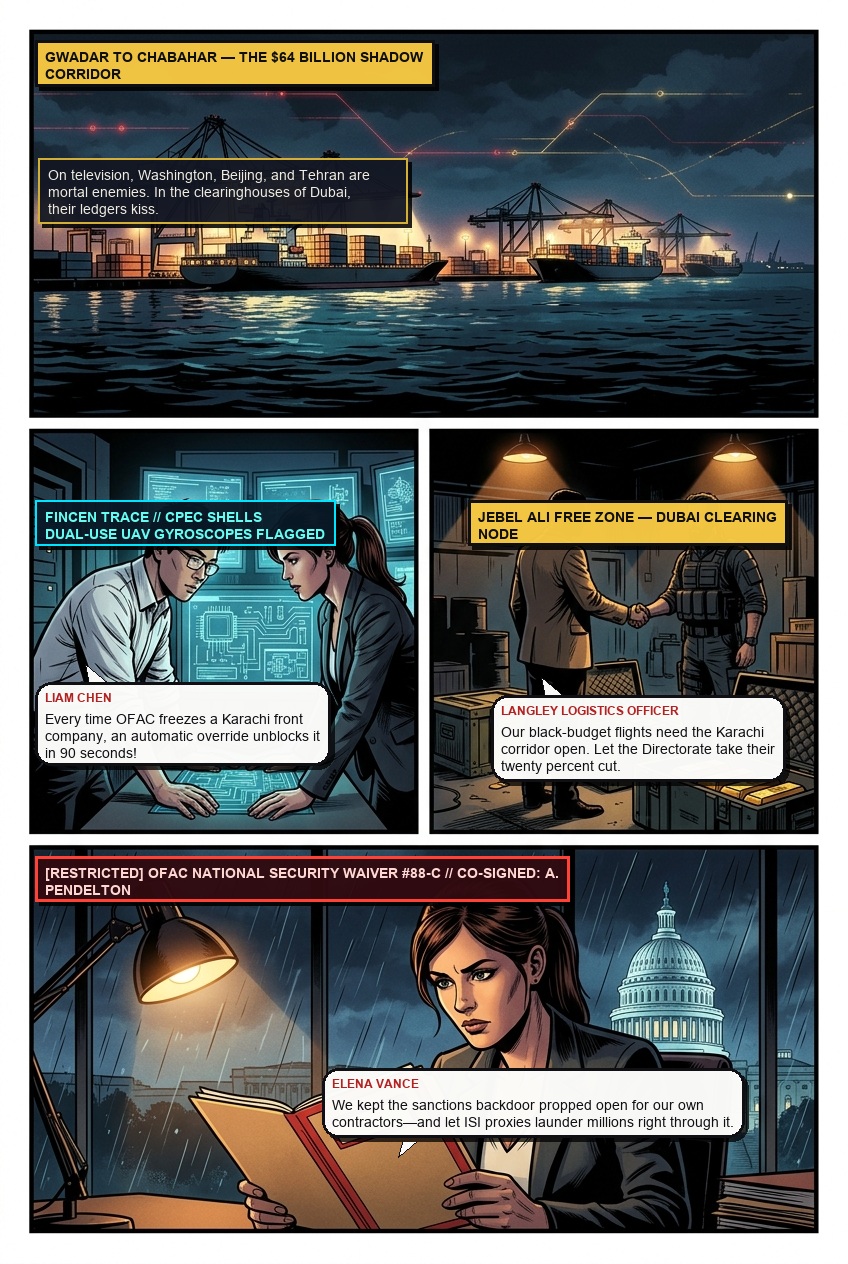
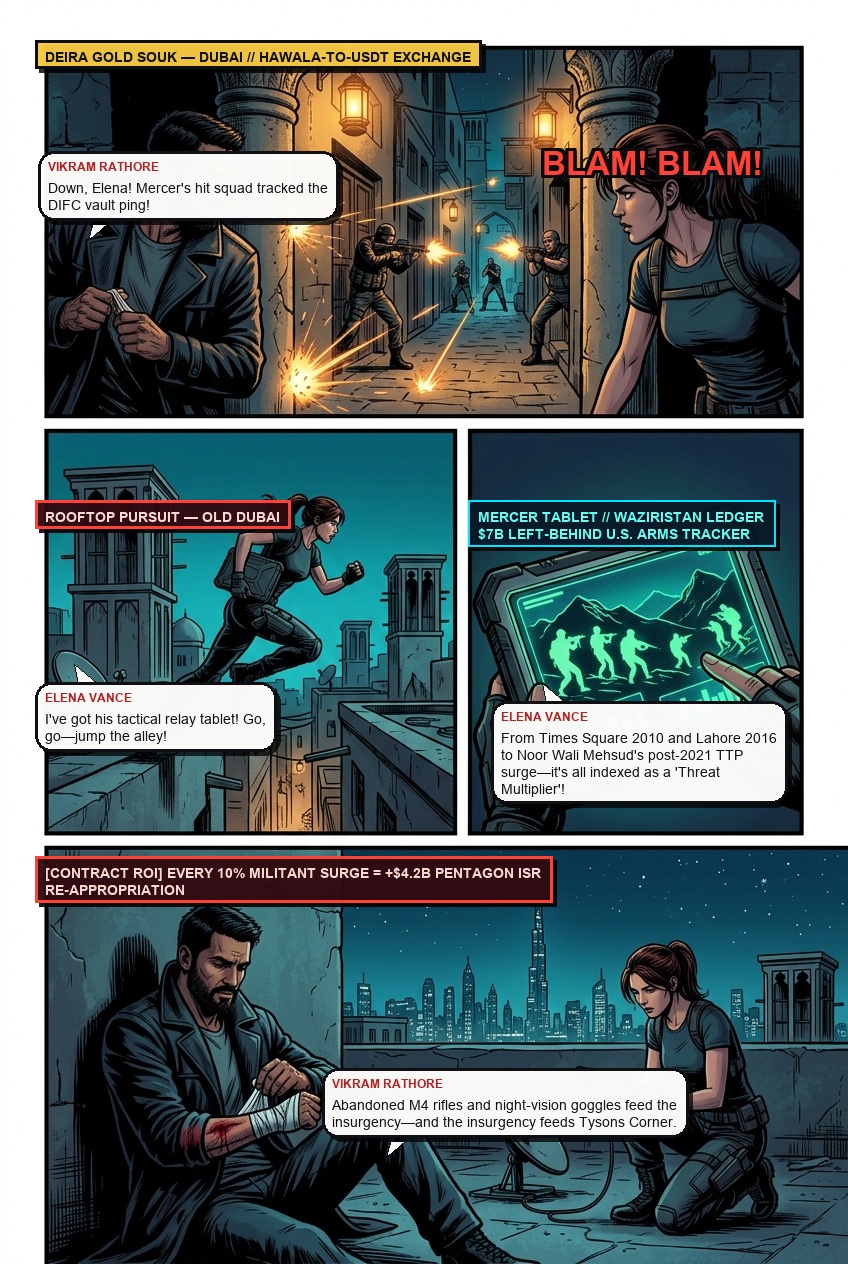
🎨 View This Chapter’s 4-Panel Graphic Novel Page (Page 1 of 16 — PROLOGUE: THE GHOST WALLET OF ISLAMABAD) Click to Expand / Collapse ▼
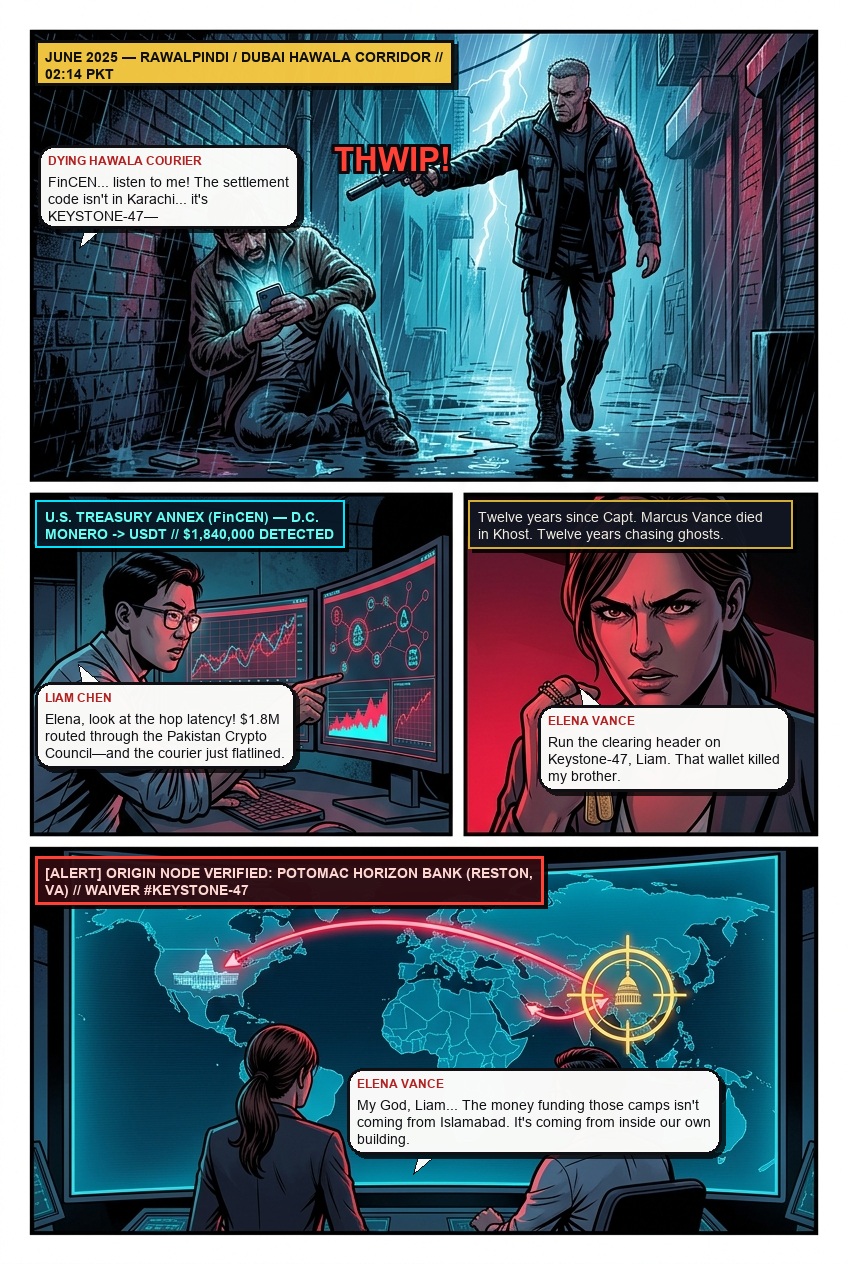
The monsoon did not fall on Rawalpindi; it detonated.

Violent sheets of grey water tore through the eucalyptus canopy along the Margalla Hills, drowning the hum of diesel generators and cloaking the razor-wire perimeters of Sector G-5. Three weeks after India’s Operation Sindoor—a devastating series of surgical strikes that had turned seven cross-border launchpads along the Line of Control into smoking craters of shattered pine and pulverized concrete—the twin cities were locked down under military curfew. Armored personnel carriers with blackened windows idled at every intersection from Chaklala to Zero Point.

Four stories beneath the mud-slick tarmac of an unmarked telecommunications switching station off the Kashmir Highway, the air was cold, dry, and smelled of ozone.

Inside Bunker 9, there were no windows, no badges, and no clocks. Just thirty dual-screen workstations arranged in concentric rings around a glowing digital display of the South Asian theatre. The room belonged to Directorate S—the clandestine operational nerve center of Pakistan’s Inter-Services Intelligence.

A young technician with bloodshot eyes and the rank of captain in the Pakistan Army Signals Corps stared at an amber cursor blinking across an air-gapped terminal. His headset crackled with low-frequency static. On his second monitor, a proprietary software daemon labeled Sikandar-IV was executing a programmed liquidity tumble.

"Node confirmed," the captain muttered in Urdu, his fingers trembling above the mechanical keys. "Routing through the Karachi exchange portal. Decoupling from the public mempool."

Across the desk, a civilian contractor wearing a tailored shalwar kameez and a lanyard with the crest of the Pakistan Crypto Council—the state-sanctioned digital asset board established only four months earlier—checked a countdown timer on his encrypted phone.

"Don’t look at the IP signatures," the contractor murmured, not looking up. "Just push the block. The clearing code is already signed from Virginia."

The captain hesitated for a fraction of a second. His screen displayed the outbound payload: 1,450 Monero tokens, their ring signatures obfuscated through twenty-seven dummy outputs, converting across decentralized cross-chain bridges into exactly $1.85 million in Tether. The destination was not a foreign bank or a Swiss numbered account. It was an unhosted hardware wallet whose public key began with a sequence that defied all modern cryptography: 0x47_KEYSTONE.

The captain pressed Enter.

On the central projector, a single red packet pulsed once, slipped through a fiber-optic conduit under the Arabian Sea, and vanished into the global financial ether.


Seven thousand miles away, in Washington, D.C., the rain had stopped, leaving Pennsylvania Avenue slick beneath the glow of sodium-vapor streetlights.

The U.S. Treasury Annex sat directly across from the East Wing, its neoclassical limestone facade projecting an air of sober, unyielding permanence. But four floors beneath the street, inside the windowless subterranean warren of the Financial Crimes Enforcement Network—FinCEN—the atmosphere had the frantic, caffeine-sour hum of an intensive care unit at midnight.

Elena Vance sat alone at Workstation 14 in the Office of Special Investigations. She was thirty-six, with sharp, angular features, dark hair pulled back into a utilitarian knot, and dark circles under her hazel eyes that concealer could no longer hide. A lukewarm paper cup of black coffee sat beside her keyboard, cold film floating on its surface.

Tucked beneath the left corner of her mousepad was a tarnished steel dog tag on a beaded chain: VANCE, MARCUS E. — CAPT — US ARMY — O-POS.

Marcus had been twenty-eight when a command-wire IED tore through his Stryker outside Khost in 2012. Thirteen years later, the dust of Paktia province still seemed to coat the inside of Elena’s throat whenever she stared into the dark. The military had called it a tragic casualty of war, pinning the blame on an elusive Haqqani Network sub-commander who had evaporated into the tribal hills of North Waziristan. But Elena had not joined the Treasury to accept official summaries. She had joined because she knew a fundamental truth that generals and diplomats spent their lives denying: an army does not move on its stomach. It moves on its ledgers.

"Elena."

The voice came from across the partition. Liam Chen, twenty-nine, FinCEN’s most gifted dark-web forensic architect, was leaning forward until his nose almost brushed his quad-monitor rig. His tie was undone, his sleeves rolled to his elbows, exposing forearms pale from seventy-hour workweeks.

"Tell me you’re looking at the Deira hawala feed," Liam whispered, his voice cracking with fatigue.

Elena pivoted in her ergonomic chair, her eyes tracking the cascade of data Liam pushed to her central monitor. "I’m looking at the Pakistan Crypto Council node. Did they just liquidate?"

"They didn't just liquidate," Liam said, his fingers flying across his keyboard like a concert pianist. "They cascaded. One point eight-five million USDT. Masked through three layers of stealth addresses on the Monero blockchain, then dumped straight into an over-the-counter liquidity pool in Dubai. Look at the transaction timestamp. 04:12 UTC. That’s Rawalpindi time, 09:12 AM."

Elena zoomed in on the visual graph. The cluster looked like a tangled web of spider silk, hundreds of micro-transactions collapsing into a single, dense nexus. "Who took the payout on the Dubai end?"

"That’s the crazy part," Liam said, pulling up an encrypted intercept from the Joint Special Operations Command liaison desk in Tampa. "It wasn't a cold wallet in the Emirates. It was an off-book settlement. A physical cash drop in the Deira Gold Souk. And our asset on the ground just tripped an alarm."

Elena felt the hair on the back of her arms stand up. "What asset?"

"Tariq Al-Husseini," Liam replied, tapping a key. "Old-school Omani money courier. He’s been moving black-bag money between Karachi, Dubai, and Peshawar since the Soviet invasion. Langley has had him on a payroll retainer for fifteen years under Operation Blue Horizon. He was supposed to intercept the paper chit."

Elena leaned in, her eyes narrowing. "Put the live audio through the SCIF."

Liam plugged in a set of over-ear tactical monitors and split the signal.

Through the headset, the background noise was overwhelming: the wet roar of a Dubai alleyway in the sweltering Arabian night, the metallic clatter of rolling security shutters, and the ragged, choking breath of a man drowning in his own blood.

“...Al-Husseini,” a voice hissed through the static. It was an American voice, flat, clipped, devoid of any accent or hesitation. The cadence of a Tier-One operator. “The recovery key. Where did they mirror the cold archive?”

A wet, agonized cough followed. Tariq Al-Husseini was on the concrete. “Wallah... it is not... it is not Rawalpindi’s...”

“The key, Tariq.”

Elena gripped the edge of her desk. "Liam, trace the geolocation of that transmitter. Now!"

"I'm trying! The signal is bouncing off a military transponder over Al Dhafra—"

Through the headset came the sound of rain, or perhaps water dripping from an air conditioning unit into a metal gutter. Then, Al-Husseini’s voice rose, thin and trembling with terror, speaking directly into the microphone concealed in his collar:

“Tell them... in Washington... the ledger never closed... It is Keystone-47... Uncle Sam’s own—"”

Crack.

The muffled thud of a suppressed .300 Blackout round tore through the speaker, followed instantly by a second, duller impact. The courier’s breath collapsed into a hollow rattle.

Silence swallowed the channel, save for the hum of the city. Then, the sound of boots turning on wet gravel. A brief rustle as someone retrieved the courier's phone.

For four agonizing seconds, there was only the sound of rhythmic breathing on the other end of the line. Then, whoever held the phone spoke, not to the dead man on the pavement, but directly into the open microphone.

"Clear the channel, Vance," the voice said calmly. "You’re auditing ghosts."

The connection severed. A flat dial tone droned through Elena’s headphones.

Elena sat frozen, her blood running cold as ice water. The caller had spoken her name. Not FinCEN. Not Treasury. Vance.

Liam stared at his terminal, his face completely drained of color. "Elena... how did he know you were on the intercept? That channel was classified SAP-Silver. Only six people in this building have decrypt keys."

Elena slowly removed the headset and laid it on the desk next to Marcus’s dog tag. Her hands were steady, but inside, a trapdoor had just swung open over an abyss.

"He knew because he isn't outside the fence, Liam," she said softly, her eyes fixed on the blank screen where the transaction had terminated. "Keystone-47. Run that alphanumeric through the Suitland historical archives. Don't touch the FinCEN servers. Use the isolated Cold War microfilm index."

"Elena, what is Keystone-47?" Liam asked, his voice barely a whisper.

Elena stood up, smoothing the wrinkles from her dark blazer. The memory of her brother’s flag-draped casket at Arlington flashed behind her retinas.

"It’s not a terrorist cell," Elena said. "It’s a U.S. government billing code."
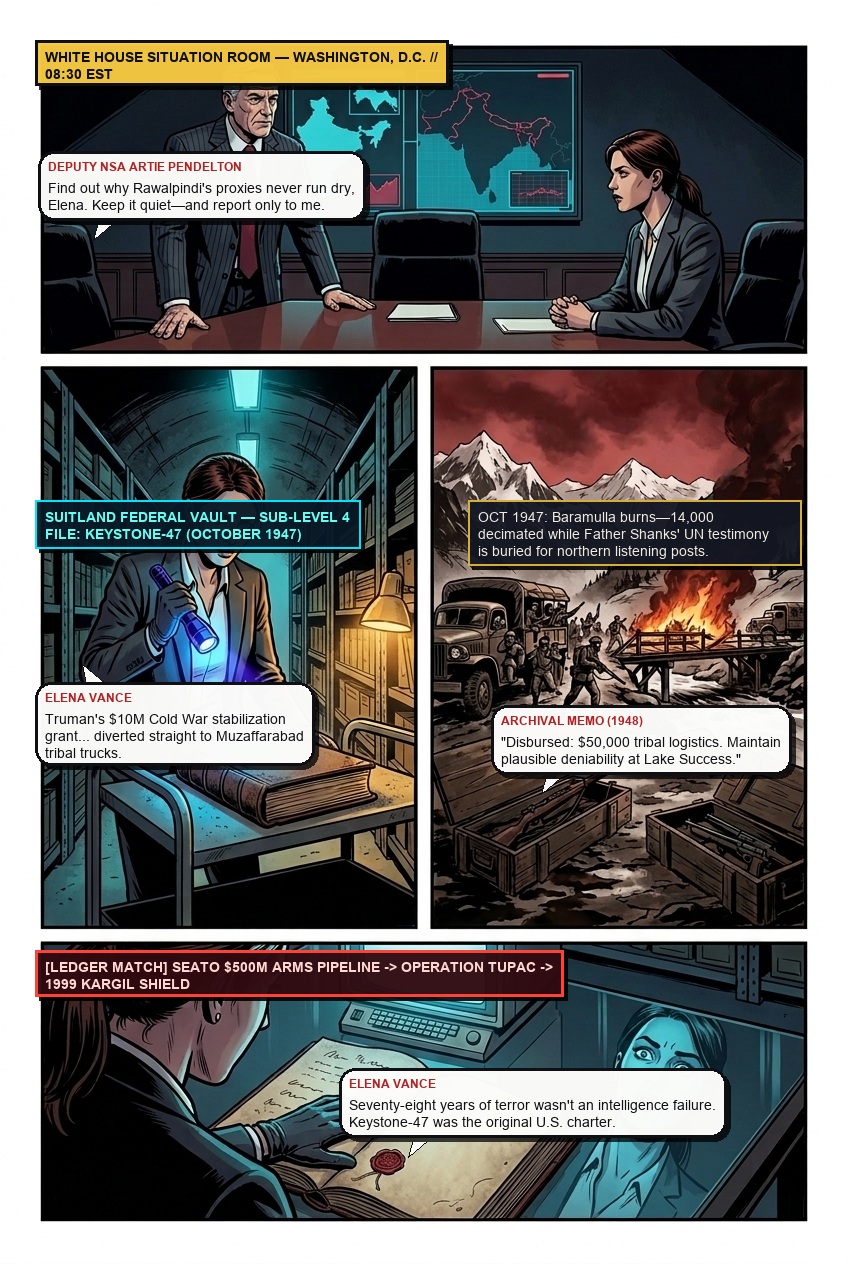
Act I • The Trail Opens • Chapter 1 The Potomac Ledger • A Thriller by Anand Dubey

The Kashmir Gambit

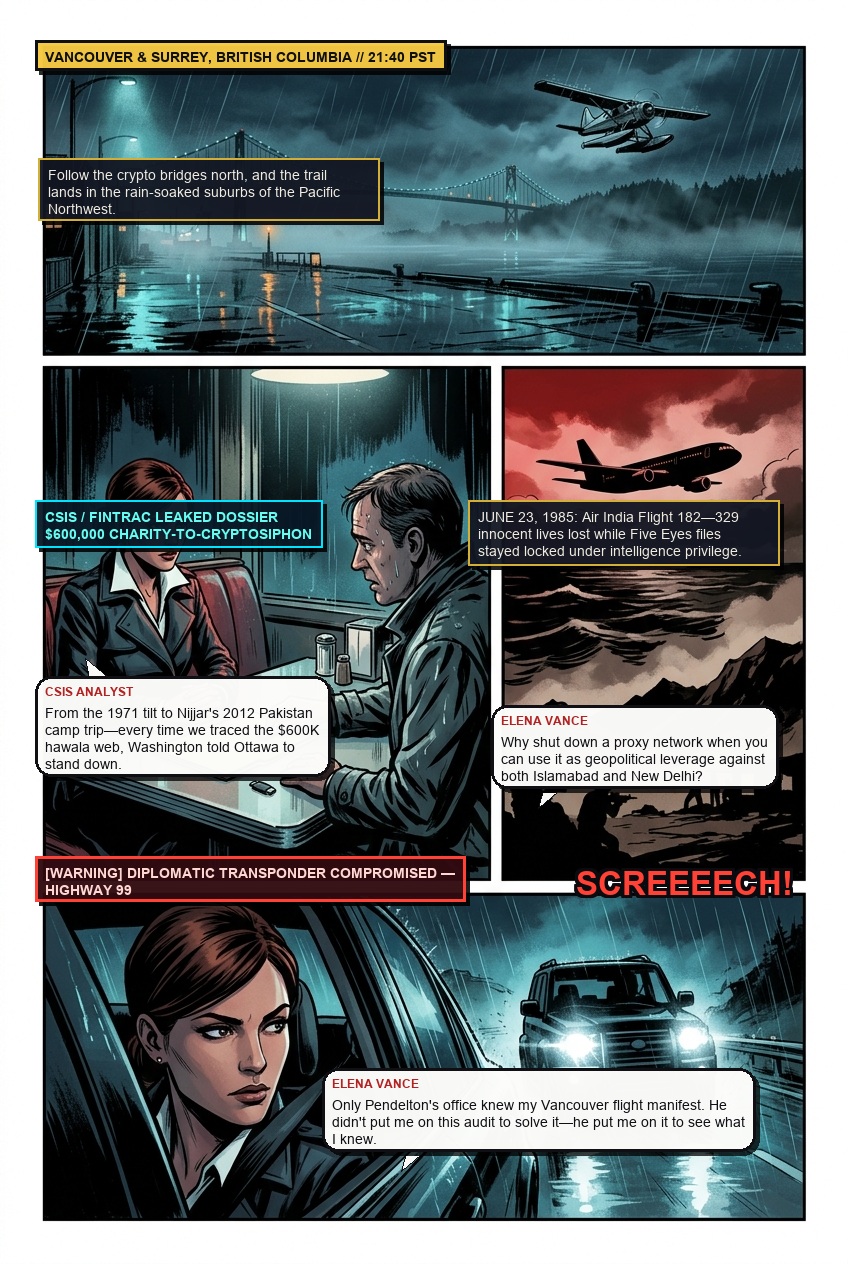
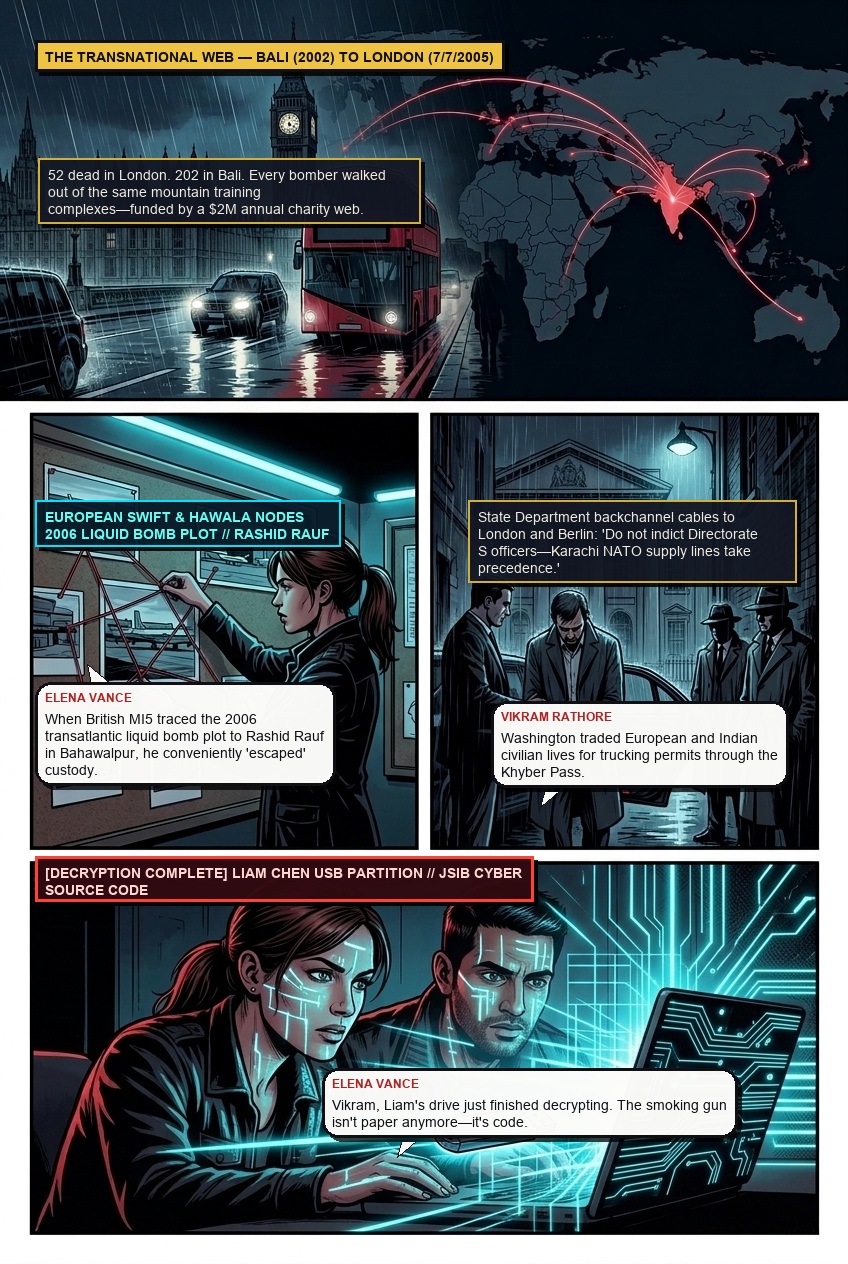
🎨 View This Chapter’s 4-Panel Graphic Novel Page (Page 2 of 16 — CHAPTER 1: THE KASHMIR GAMBIT) Click to Expand / Collapse ▼

The White House Situation Room smelled of furniture polish, recycled ozone, and the quiet desperation of men who had spent forty years running the world on borrowed time.

At 0645 hours, the mahogany conference table was empty except for a single bone-china teacup, an uncreased copy of the President’s Daily Brief, and Arthur "Artie" Pendelton.

At sixty-one, Pendelton looked like the quintessential Georgetown patrician: silver hair swept back with tailored precision, rimless titanium spectacles, and a charcoal bespoke suit draped over a slate-grey cashmere vest. He had spent three decades in the shadows of the Directorate of Operations—climbing from the CIA’s Near East Division in Islamabad during the Soviet jihad to the inner sanctum of the National Security Council.

When Elena Vance walked through the blast door, Pendelton didn't immediately look up. He poured two fingers of steaming Darjeeling tea from a silver pot into a second cup and gestured smoothly toward the leather chair opposite him.

"You look like you haven't slept since the Sindoor strikes, Elena," Pendelton said. His voice was smooth, a cultured baritone cultivated in Ivy League debating societies and polished in diplomatic safe houses.

"I haven't," Elena said, taking the seat but ignoring the tea. "And neither has FinCEN. We caught a liquidity drain out of Rawalpindi at 0412 UTC. One point eight-five million in Tether, laundered through the Pakistan Crypto Council. An Omani courier in Deira caught two rounds in the skull five minutes later."

Pendelton’s hand remained steady as he lifted his cup. "Tariq Al-Husseini. Yes. The Station Chief in Dubai notified me twenty minutes ago. An unfortunate casualty of an overheated souk. Deira has always been a rough neighborhood for cash handlers."

"He was an active CIA asset, Artie," Elena said, her voice dropping into a low, lethal register. "And before Cole Mercer put a bullet in his forehead, Al-Husseini screamed a name into our open intercept. He said Keystone-47. Then Mercer addressed me by name."

For the briefest fraction of a second, Pendelton’s eyelids twitched. The silver spoon in his saucer made no sound.

"Cole Mercer is an independent security contractor, Elena. He operates in private commercial spaces across the Gulf," Pendelton said, his tone dismissing the accusation before it could take root. "What you heard was an echo chamber. When a city like Rawalpindi panics after Indian airstrikes, every back-alley bookie claims he’s running a state secret."

Pendelton opened a leather folder embossed with the seal of the National Security Council and slid a document across the polished mahogany. It was an Executive Action Directive stamped TOP SECRET / ORCON / SPECTRUM.

"The President is unhappy, Elena," Pendelton said softly. "Operation Sindoor came within twenty nautical miles of triggering a full nuclear exchange between two states with three hundred combined warheads. New Delhi is furious. They’ve provided satellite telemetry proving that the suicide squad that hit their military convoy in Uri last month trained at a Jaish-e-Mohammed facility three miles from Abbottabad. The Indians are asking a very blunt question: How is it that after seventy-eight years of American partnership, twenty-two FATF plenary sessions, and tens of billions of dollars in U.S. counterterrorism assistance, Lashkar-e-Taiba and Jaish-e-Mohammed are still operating with corporate-level budgets?"

Elena stared at the directive. Her name was listed as Lead Special Investigator.

"You want an audit," she said.

"I want a firewall," Pendelton corrected, leaning forward, resting his forearms on the table. "I need an unassailable, comprehensive forensic accounting report that explains the regeneration of these proxy groups. We know the narrative: rogue colonels in Directorate S, black-market Chinese hawala syndicates, Gulf private donors operating beyond state control. Show how the money bypasses official Pakistani state oversight. Give me a paper I can hand to the Indian National Security Advisor next week in Geneva that insulates the bilateral relationship."

Elena looked at Pendelton’s patrician face. She saw the calculation behind the rimless lenses. He didn't want an audit; he wanted a whitewash. He wanted her reputation—the unyielding, grief-hardened sister of a fallen captain—to sign off on a fiction.

"And if the money doesn't bypass official channels?" Elena asked quietly.

Pendelton smiled, a thin, patronizing crescent. "Forensics is like scripture, my dear. If you read it with the proper context, it always delivers peace. Report directly to me. Vault clearance Level-5 is activated on your badge. Start at the archives."


Two hours later, Elena was thirty feet beneath the damp soil of Prince George’s County, Maryland.

The Washington National Records Center at Suitland was an immense, subterranean fortress of steel shelving, concrete pillars, and chilled, dehumidified air that smelled of decaying cellulose and industrial disinfectant. Here sat the physical paper trail of the American century: millions of cubic feet of carbon paper, microfiche, and classified state records that had never been digitized, shielded from the sun and public scrutiny by six feet of reinforced rebar.

Elena navigated the labyrinthine aisles of Vault 4B, pulling a wheeled steel utility cart behind her. Her FinCEN credentials had bypassed three biometric checkpoints, but the ledger she was looking for wasn't indexed in the modern Treasury mainframe.

She stopped at Row 84, Shelf C, where dozens of heavy grey archival boxes were sealed with faded red lead bands. The stenciled lettering on the metal tab read: DEPT OF TREASURY / FOREIGN FUNDS CONTROL / 1947–1954 / RESTRICTED ACCESS — CODE: KEYSTONE.

Her pulse hammered in her throat as she cut the lead seal with a utility knife.

Inside sat leather-bound binders with yellowed onion-skin pages, typed on mechanical Remingtons in the late autumn of 1947. Elena pulled out the ledger labeled VOL. 1: SOUTH ASIA SPECIAL CONTINGENCY DISBURSEMENTS — OCT 1947.

She set the binder under the halogen desk lamp, pulled on white cotton gloves, and opened the cover.

The documents were breathtaking in their clinical brutality.

For seventy-eight years, the official history taught in Western textbooks and State Department white papers held that the October 1947 invasion of Kashmir was a spontaneous uprising of aggrieved Pashtun tribesmen—an organic lashkar that crossed the border from the North-West Frontier to liberate their brethren from the Maharaja of Kashmir.

The ledger told a radically different story.

Before her lay the signed carbon receipts of Account Keystone-47, established in September 1947 under President Harry Truman’s executive foreign stabilization authority. Ten million dollars in post-WWII emergency reconstruction credits had been transferred from the Federal Reserve Bank of New York to the newly formed Imperial Bank of Pakistan in Karachi.

Elena’s eyes traced the disbursements. Exactly $50,000—a colossal sum in 1947—had been debited on October 18, 1947, categorized under "Tribal Logistics and Transport Support — Muzaffarabad Sector."

The voucher listed the exact purchase orders: three hundred British-made Bedford trucks, 100,000 gallons of high-octane aviation fuel diverted from RAF surplus, and five thousand Lee-Enfield .303 rifles. The logistics coordinator who co-signed the receipt was not an obscure tribal chieftain; it was Major General Akbar Khan of the Pakistani General Staff, operating under the pseudonym General Tariq.

Elena flipped the fragile pages, her fingers cold.

Tucked into an annex folder marked UNCIP / EXHIBIT-B / SUPPRESSED was a typewritten deposition taken in November 1947 by Father Shank, an American-educated Belgian priest at St. Joseph’s Convent and Hospital in Baramulla.

Elena read the priest's trembling, unredacted words:

"The raiders arrived in military trucks bearing official transport markings. For seventy-two hours, Baramulla was turned into an abattoir. Mother Superior Aldegruda was shot point-blank while protecting the maternity ward; Sister Teresalina was raped and butchered with bayonets alongside patient beds. Over fourteen thousand innocent souls—Hindus, Sikhs, and local Muslims who refused to join the plunder—were exterminated in the streets. The hospital was burned to its foundations. When we showed the ammunition casings to the UN Commission observers, they were stamped with U.S. ordnance marks from the Pacific Theatre..."

Elena looked at the margin of Father Shank’s statement. In neat, fountain-pen cursive, a State Department liaison officer had scrawled a note dated January 12, 1948:

‘Father Shank’s deposition to be sealed under National Security Directive 4-A. Under-Secretary Lovett concurs. Publication would compromise ongoing negotiations regarding the Gilgit airfield and intelligence listening posts aimed at Soviet Central Asia. The tribal narrative stands.’

"Jesus Christ," Elena whispered into the empty vault.

They knew. From day one. From the very hour the first match was struck in Kashmir.

She turned to the second volume: the 1950s.

When the Korean War broke out, Washington expanded the pipeline. Under President Dwight D. Eisenhower and Secretary of State John Foster Dulles, Pakistan was inducted into SEATO and CENTO—hailed as America’s "most allied ally in Asia." The ledger showed the reality: over $500 million in military aid poured into Rawalpindi between 1954 and 1959. Officially, the Patton tanks, F-86 Sabre jets, and millions of rounds of heavy ammunition were earmarked to deter Soviet expansionism.

Yet Elena’s eyes locked onto the audit cross-references: over sixty percent of the SEATO armor was immediately redeployed along the Punjab and Kashmir borders. When Pakistani planners launched Operation Gibraltar in 1965, sending thousands of commando infiltrators into the Kashmir valley, they rode in U.S.-supplied armored vehicles and fired Browning machine guns paid for by American taxpayers.

The pattern repeated with terrifying mathematical regularity. In the late 1980s, under General Zia-ul-Haq, the blueprint was codified into Operation Tupac—the strategy of inflicting "a thousand cuts" on India through deniable militant proxies. And when the Kargil War exploded in the summer of 1999, the Northern Light Infantry troops who seized the icy peaks of Batalik and Tololing were wearing U.S.-supplied extreme-cold-weather parkas and navigating with Rockwell GPS receivers provided under American counter-narcotics grants.

Washington hadn't failed to stop Pakistan's terror infrastructure. Washington had financed its foundational architecture. They traded fourteen thousand corpses in Baramulla, and thousands more across decades of bloodshed, for radio towers in Peshawar and Gilgit to eavesdrop on Moscow and Beijing.

Elena pulled her encrypted phone from her pocket and snapped high-resolution RAW images of the 1947 ledgers, the signed receipts, and Father Shank’s suppressed testimony.

As she lowered the phone, she heard the heavy metallic click of a deadbolt sliding into place at the far end of Vault 4B.

The hum of the ventilation system suddenly stopped.

The vault went dead silent.

Elena slipped the phone into her inner jacket pocket, her hand closing instinctively around the Glock 19 holstered at her hip.

From the darkness beyond Row 90, the sound of slow, deliberate footsteps echoed across the concrete.

Act I • The Trail Opens • Chapter 2 The Potomac Ledger • A Thriller by Anand Dubey

The Unholy Clearinghouse

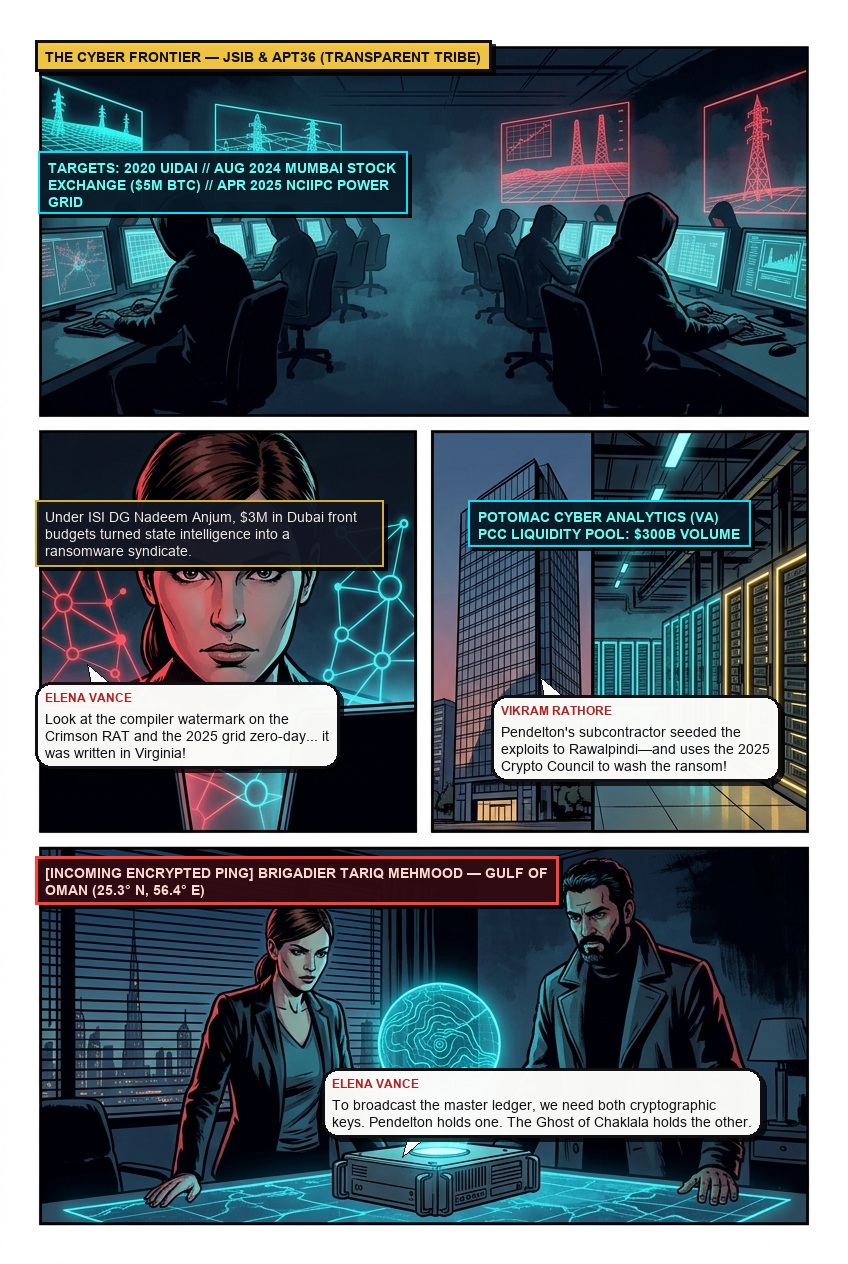
🎨 View This Chapter’s 4-Panel Graphic Novel Page (Page 3 of 16 — CHAPTER 2: THE UNHOLY CLEARINGHOUSE) Click to Expand / Collapse ▼

The shadow at the end of Row 90 did not draw a gun.

Instead, a stooped, elderly archivist pushing a squeaking cart of declassified agricultural census records shuffled past the stacks, his eyes locked on a plastic clipboard. Elena Vance exhaled slowly, her fingers releasing their white-knuckle grip on the Glock concealed beneath her blazer. She did not wait for the archivist to ask for her authorization chit. She took the emergency service elevator directly to the ground floor, pushed through the heavy security turnstiles, and drove her unmarked sedan straight back into the subterranean heart of the Treasury Annex.

By 1400 hours, Workstation 14 was locked down behind an impenetrable biometric air-gap.

Liam Chen sat hunched over a terminal flanked by three empty espresso cups and a half-eaten protein bar. The blue glow of his quad-screen array reflected across his wire-rimmed glasses, painting his pale face in ghostly hues.

"Tell me you brought back something better than dust and depression," Liam said, without taking his eyes off a scrolling cascade of SWIFT clearing logs.

"I found the birth certificate," Elena said, locking the SCIF door and sliding her encrypted thumb drive into Liam’s dedicated sandbox terminal. "Truman funded the 1947 Muzaffarabad invasion with $10 million in post-war reconstruction credits. Eisenhower topped it off with half a billion in SEATO armor. Washington knew about the Baramulla massacre before the bodies were cold, and they buried Father Shank’s testimony to protect listening posts in Gilgit."

Liam didn't blink. His expression was that of a man who had stared into the digital sewer so long that fresh sewage no longer smelled foul.

"Well," Liam murmured, tapping his keyboard, "the listening posts are still open, but the landlords have changed. Pull up Node-7 on my second screen."

Elena leaned over his shoulder. The screen populated a multi-layered financial network graph. At its center sat a sprawling, three-headed monster: the Pakistan-Iran-China Axis.

"The $64 billion China-Pakistan Economic Corridor," Elena observed, reading the primary nodes. "Gwadar to Kashgar. The Karakoram Highway."

"It's not just concrete and asphalt," Liam explained, dragging a cursor over a series of interconnected corporate entities. "CPEC is the world’s most sophisticated trade-based money laundering machine. Look at the logistics flow. Over the past twenty-four months, three shell companies incorporated in the Jebel Ali Free Zone in Dubai have been coordinating maritime freight between Gwadar and Chabahar."

Elena read the names aloud: "Karakoram Logistics FZE, Indus Caspian Trading, and Al-Fajr Maritime Services. What are they shipping?"

"Officially? Heavy construction aggregate, marine diesel, and high-voltage grid components for the Gwadar deep-water port," Liam said, pulling up maritime bills of lading and customs declarations from the port authorities in Karachi. "Unofficially? Dual-use military electronics. Drone guidance modules from Shenzhen. High-frequency frequency-hopping tactical radios manufactured under license in Germany. Infrared thermal-imaging sensors manufactured in Austria."

Elena’s forensic instincts immediately locked onto the pricing discrepancies. "The unit valuations are absurd. Look at these invoices for industrial diesel pumps. Invoiced at $450,000 per unit; fair market value is barely $40,000. That’s a 1,000 percent markup."

"Trade-based over-invoicing at industrial scale," Liam nodded. "The Chinese contractors pump billions in yuan and U.S. dollar loans into Pakistani state escrow accounts. The Pakistani state entities pay out these bloated invoices to Indus Caspian Trading in Dubai. The surplus cash—tens of millions of dollars—sits in unmonitored escrow accounts in the UAE. From there, it splits into two streams."

Liam traced the digital lines with his finger.

"Stream One: It crosses the border into southeastern Iran via the Chabahar smuggling corridor, paying off IRGC border guards and purchasing Iranian light crude to fuel shadow transport networks across Balochistan. Stream Two: It converts into unhosted Tether wallets controlled directly by Directorate S in Rawalpindi. This is the operational slush fund that finances cross-border launchpads for Lashkar-e-Taiba in Kashmir and Jaish-e-Mohammed in southern Punjab."

Elena pulled a chair up beside him, her brow furrowed. "This doesn't make sense, Liam. Gwadar and Chabahar have been under Tier-One Treasury monitoring for a decade. Every dollar-clearing transaction through the Jebel Ali Free Zone routes through a correspondent account in New York or London. Why hasn't FinCEN frozen these accounts? Where are the OFAC Specially Designated Nationals sanctions?"

Liam swiveled his chair to face her. His expression was grim. "That’s what I spent the last three hours digging into. I tried to pull the Section 311 Patriot Act designation on Karakoram Logistics FZE. The system didn't give me an error, Elena. It gave me a bypass."

"What kind of bypass?"

"A classified National Security Waiver," Liam whispered, leaning closer. "Document classification: TOP SECRET / NOFORN / MAJESTIC. Issued under OFAC’s extraordinary statutory authority. Signed right here inside the Beltway."

Elena felt an icy chill prickle down her spine. "Who signed it?"

Liam entered an override code. The screen flashed amber, then decrypted a scanned PDF bearing the golden eagle seal of the Office of Foreign Assets Control.

At the bottom of the memorandum sat two signatures.

The first was the Under-Secretary of the Treasury for Terrorism and Financial Intelligence.

The second signature belonged to the Deputy National Security Advisor: Arthur Pendelton.

Elena stared at the signature, the black ink bold, unhesitating, arrogant.

"Read the operational justification paragraph," Liam urged quietly.

Elena read the declassified annex:

‘...The subject entities (Karakoram Logistics FZE, Indus Caspian Trading) are hereby granted continuous non-enforcement clearance under OFAC General License 88-C. Interdiction of correspondent dollar clearing through Dubai and Karachi would irrevocably compromise ongoing joint intelligence collection platforms targeting the Chinese naval deployment at Gwadar and Iranian nuclear enrichment facilities in Sistan-Baluchistan. Clandestine transit channels utilized by friendly defense contractors and CIA Near East Division logistics officers require uninterrupted liquidity across the Gwadar-Chabahar corridor. Any financial collateral leakage toward local security auxiliaries is deemed an acceptable operational cost.’

"Acceptable operational cost," Elena repeated, her voice shaking with quiet fury.

The pieces snapped together with horrifying clarity.

Washington hadn't left a sanctions loophole open through bureaucratic incompetence. They had deliberately engineered a permanent financial blind spot in Dubai and Karachi. American defense contractors and CIA operational platforms needed a backdoor to move black-budget communication arrays, pay off Iranian informants, and spy on Chinese naval expansion at Gwadar.

To keep their own dirty pipes flowing, the Beltway intelligence barons had signed waivers that allowed the Pakistani military and Chinese contractors to launder billions through the exact same channel. And the "collateral leakage" that Artie Pendelton had signed off on with a flick of his fountain pen was the very money paying for the suicide vests, sniper rifles, and drone optics tearing through Kashmir and the tribal belts.

"They're leasing the sewer," Elena said, her voice hollow. "They built the pipe to spy on Beijing and Tehran, and they let Rawalpindi charge a toll in blood."

"It gets worse," Liam said, his voice dropping another octave. He opened a background corporate registry filed with the Delaware Department of Corporations. "Indus Caspian Trading isn't wholly owned by Pakistani nationals or Gulf sheikhs. Forty percent of the voting shares are held by a Delaware-registered shell entity called Potomac Horizon Group."

Elena looked up sharply. "Potomac Horizon? Pendelton’s old consultancy?"

"The very same," Liam said. "Pendelton resigned from the board when he took the Deputy NSA slot, but his blind trust still holds a fifteen percent equity stake. Every time a Chinese state firm overpays an invoice at Gwadar, and every time an ISI commander skims two million off the top to fund a terror camp in Muzaffarabad, Potomac Horizon collects a management fee in a private bank in Reston, Virginia."

Elena stood up, pacing the narrow confines of the SCIF. The walls felt like they were closing in. Her brother’s death, the massacre at Baramulla, the burning launchpads of Operation Sindoor—they weren't separate tragedies scattered across eighty years of history. They were line items in a single, continuous, self-funding enterprise.

"Liam," Elena said, stopping by his shoulder. "Can you pull the cross-border wire feeds from North America into these accounts? If Potomac Horizon is moving money through Dubai, where is the Western diaspora money entering the stream?"

Liam hit a command string. A new cluster of transactions flared across the map, tracing an unbroken red arc straight out of the Pacific Northwest and southern Ontario.

"Vancouver," Liam said, squinting at the coordinates. "And Toronto. Six hundred thousand dollars in peer-to-peer crypto chits moved out of British Columbia three weeks ago. Destination: a Directorate S logistics clearinghouse in Lahore."

Elena grabbed her jacket and badge from the desk.

"Book me on the next commercial flight to Vancouver," she said. "I need to talk to CSIS before Pendelton realizes I’ve read his waivers."

"Elena, wait," Liam said, reaching out to catch her sleeve, his face pale with dread. "If Pendelton signed those waivers, he’s monitoring FinCEN's internal query logs. He knows what we just searched. You're walking into the open."

Elena looked down at the tarnished steel dog tag resting beside the keyboard.

"I’ve been in the open for thirteen years, Liam," she said grimly. "Let them come."

Act I • The Trail Opens • Chapter 3 The Potomac Ledger • A Thriller by Anand Dubey

The Northern Sanctuary

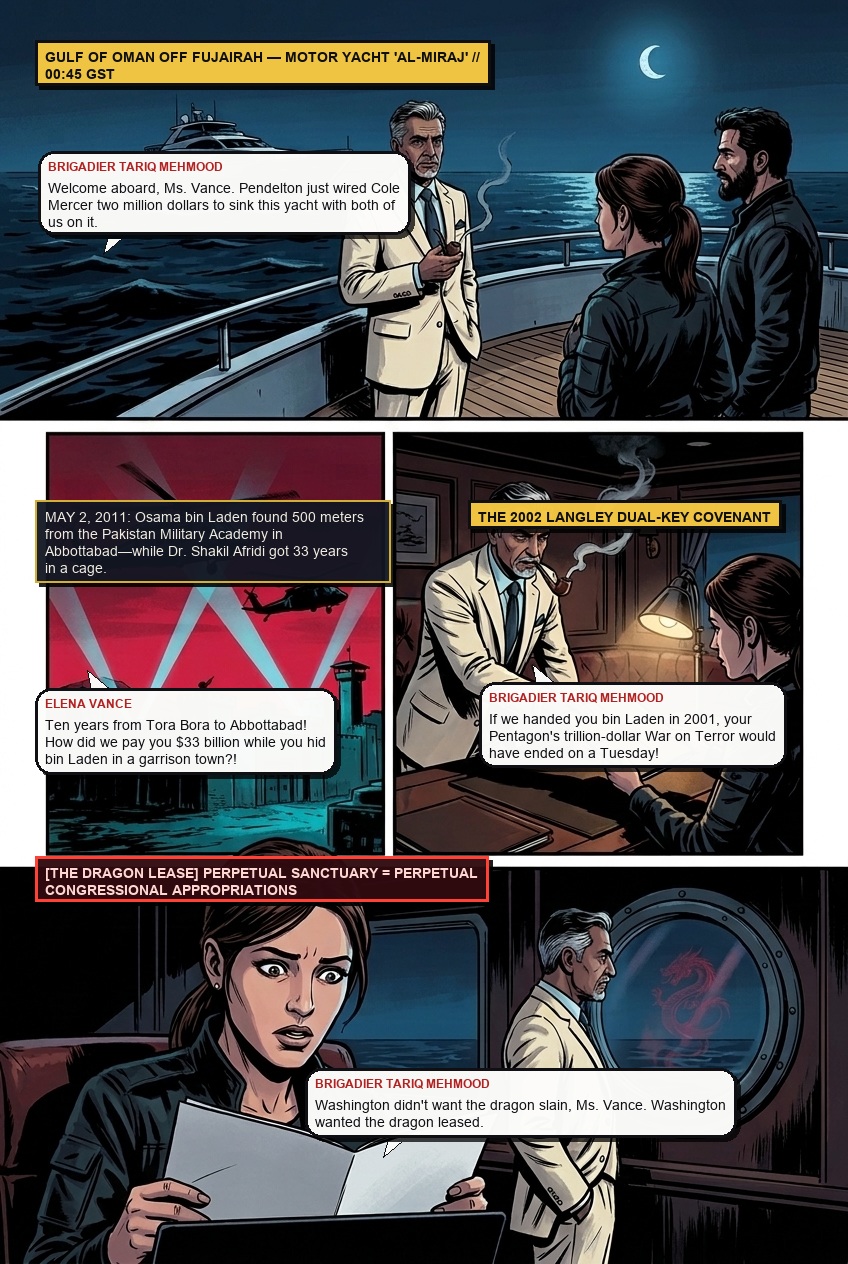
🎨 View This Chapter’s 4-Panel Graphic Novel Page (Page 4 of 16 — CHAPTER 3: THE NORTHERN SANCTUARY) Click to Expand / Collapse ▼

The rain in British Columbia had none of the violent, theatrical thunder of an Islamabad monsoon. It fell with a quiet, relentless malignancy, a freezing grey mist rolling off the Pacific that clung to the fir trees along the Fraser River and turned the asphalt of Surrey into black ice.

Elena Vance stepped out of her rental sedan into the gravel yard of a rusted boatyard off River Road. The air tasted of salt, diesel exhaust, and wet cedar. She pulled her waterproof trench coat tight against the wind, keeping her right hand inside the pocket, her thumb resting on the safety of her concealed sidearm.

At the far end of the dock, sheltered beneath the corrugated tin overhang of a decommissioned fish processing shed, a single yellow incandescent bulb swayed in the draft.

A man was sitting on an upturned plastic crate, shivering inside a grease-stained Helly Hansen parka. He was smoking a Player’s cigarette down to the yellow filter, his fingers stained dark with nicotine.

"You took your time, Vance," he said without looking up, speaking through a cloud of grey smoke.

"Flight from Dulles was delayed on the tarmac, MacIntyre," Elena replied, stepping under the tin roof out of the drizzle. "Air traffic control had a 'system glitch.' In Washington, that usually means somebody is checking passenger manifests."

Dave MacIntyre, fifty-two, was a senior counter-terror finance analyst with the Canadian Security Intelligence Service (CSIS). He had spent twenty-five years tracking illegal money flows through Vancouver’s shadow banking networks, and he had the hollowed, grey complexion of a man whose career was built on writing reports that his political masters regularly burned.

He tossed the spent cigarette butt into the dark waters of the river and reached into a canvas duffel bag between his boots. He pulled out a battered, water-resistant Panasonic Toughbook and opened the lid.

"Six hundred thousand dollars," MacIntyre said, tapping the scuffed touchpad. "Moved across four weeks in the spring of 2024. Broken down into ninety-seven micro-transactions. Siphoned through registered charitable societies, unmonitored gurdwara donation boxes, and non-profit diaspora cultural trusts in Surrey, Burnaby, and Brampton."

Elena leaned in to inspect the ledger. "How did it leave Canada?"

"Peer-to-peer crypto desks and unhosted wallets," MacIntyre explained, scrolling through the raw blockchain telemetry. "They used cash couriers operating out of local gold jewelers on 128th Street in Surrey. Cash in Canadian dollars converts to Tether on private messaging groups. From there, the tokens jump across unhosted wallets through cross-chain privacy bridges before landing in commercial bank accounts in Lahore and Rawalpindi. The beneficiary account belongs to a logistics shell named Al-Madina Freight Services."

"A known Directorate S front," Elena muttered. "We tracked them in Kabul back in 2018."

"It’s not just a front; it’s an institutional pipeline," MacIntyre said bitterly. "And every time my team at CSIS tried to freeze these non-profit registrations or serve national security warrants on the currency exchange desks, we were hit with an administrative stop-work order from Ottawa. 'Sensitive diplomatic equities,' they called it. 'Community relations.'"

Elena looked out across the misty river. "This didn't start with crypto, Dave. How far back does this go?"

MacIntyre gave a harsh, barking laugh that dissolved into a smoker’s cough.

"How far back? Try 1971. Richard Nixon and Henry Kissinger’s great 'tilt' toward Yahya Khan during the Bangladesh Liberation War. Washington was using Rawalpindi as the back-channel broker to open relations with Mao Zedong in Beijing. While the Pakistani army was butchering three million people in East Pakistan, Nixon and Kissinger looked the other way, providing diplomatic cover and weapons shipments. And when Pakistan lost the war and their eastern wing broke away to become Bangladesh, Pakistani military planners swore they would dismember India in return. That was the birth of the Khalistan project."

MacIntyre tapped the laptop keys, opening an archival folder filled with scanned microfiche reports stamped ROYAL CANADIAN MOUNTED POLICE — DIVISION E — CLASSIFIED 1985.

"Look at this," MacIntyre said, his voice dropping into a solemn hush. "June 23, 1985. Air India Flight 182, the Kanishka. A Boeing 747 en route from Montreal to London blown out of the sky at 31,000 feet off the coast of Ireland. Three hundred and twenty-nine innocent people murdered, two hundred and sixty-eight of them Canadian citizens. Eighty-six children."

Elena’s jaw tightened. She knew the broad strokes of the atrocity—the deadliest act of aviation terrorism in history prior to September 11. But she had never seen the internal files.

"The mastermind was Talwinder Singh Parmar," MacIntyre said, pointing at a mugshot of a bearded man with piercing, fanatical eyes. "Head of the Babbar Khalsa. CSIS had Parmar under direct wiretap surveillance for months prior to the bombing. We recorded his associates buying the dynamic blasting caps; we tracked him into the woods outside Duncan on Vancouver Island where they tested the explosive device. And what did CSIS do with the wiretaps? After the plane fell out of the sky, over two hundred and eighty audio tapes were erased. Erased, Elena. By our own agency."

"Why?" Elena asked, the horror rising in her chest. "Why erase the tapes of the men who butchered 329 people?"

"Because prosecuting Parmar in open court would have exposed the Five Eyes intelligence compact’s dirtiest secret," MacIntyre whispered. "Parmar wasn't just a rogue extremist operating in the Canadian suburbs. He was an active asset of Pakistani military intelligence. He was traveling on Pakistani diplomatic assistance. And Washington and London didn't want Pakistan’s state-sponsored terror apparatus dragged into the light while General Zia-ul-Haq was managing the multi-billion-dollar CIA pipeline to the Afghan mujahideen."

MacIntyre took a deep, rattling breath, lighting another cigarette with shaking hands.

"Parmar walked free on Canadian soil. He eventually fled to Pakistan, lived in an ISI safe house in Lahore for years under official protection, and was finally killed in an encounter in Punjab in 1992. But the infrastructure remained untouched. The safe havens, the fraudulent immigration pipelines, the charity fronts—they were left completely intact."

MacIntyre clicked to a more recent file dated 2012. A surveillance photograph appeared on screen, showing a younger, stockier man standing in front of an earthen training bunker.

"Hardeep Singh Nijjar," MacIntyre said. "Entered Canada on a fraudulent passport under the alias 'Ravi Sharma' in 1997. His refugee claim was rejected for fabrication. He tried a sham marriage; rejected again. Yet he was granted Canadian citizenship. In 2012, our surveillance tracked him boarding a flight to Pakistan. He spent three weeks in an ISI training camp in the hills of Khyber Pakhtunkhwa, receiving weapons instruction and explosive handling from Pakistani army instructors. When Indian security agencies submitted red corner notices and detailed dossiers with biometric data, Ottawa buried the files."

"Because he was useful," Elena whispered.

"Because he was leverage," MacIntyre corrected coldly. "For forty years, Western intelligence agencies—CSIS, the CIA, Britain’s MI6—have viewed the separatist diaspora in North America and the UK not as a security threat, but as a permanent geopolitical choke-chain on India. Whenever New Delhi refuses to sign a trade pact, or refuses to toe the line on Western foreign policy, or buys cheap Russian crude, Washington and Ottawa pull the chain. We allow extremist networks to raise millions in cash, host public referendums calling for the balkanization of India, and run hit squads out of suburban strip malls. And if the Indian government complains, we lecture them on human rights and the sanctity of free speech."

Elena shook her head, the sheer cynicism of the architecture leaving her breathless. "And the Pakistani deep state?"

"The Pakistani deep state runs the middle," MacIntyre said. "Directorate S provides the training, the weapons channels, and the logistics. Western intelligence provides the sanctuary and the diplomatic immunity. And the diaspora provides the clean cash. The $600,000 you tracked isn't just charity fraud, Elena. It’s the operational budget for the next round of violence."

Suddenly, MacIntyre froze. His gaze darted past Elena’s shoulder toward the gravel access road.

Through the mist and the swaying cedar branches, two pairs of high-intensity LED headlights sliced through the dark. A pair of black, unmarked Ford Explorers was creeping down River Road, their engines rumbling at low idle.

"We’re blown," MacIntyre said, slamming his laptop shut and shoving it into his duffel bag. His voice was laced with blind panic. "They weren't tracking me. They followed you from Vancouver International."

"Who are they? CSIS?" Elena asked, drawing her Glock and racking the slide with a crisp metallic clack.

"CSIS doesn't drive unmarked American-spec Explorers with Washington state commercial plates," MacIntyre stammered, his face white. "Those are private contractors. Potomac Horizon’s security detail out of Seattle. If they catch you here with this data, neither of us makes it out of the river."

The lead Explorer accelerated, gravel crunching violently under wide off-road tires. A blinding roof-mounted spotlight snapped on, pinning Elena and MacIntyre against the tin wall of the fish shack.

"Move! Through the processing floor!" Elena yelled.

MacIntyre bolted toward a rusted side door, kicking it open. Elena fired two rounds into the radiator grille of the lead Explorer. The sharp cracks of the 9mm rounds shattered the wet silence, steam hissing violently from the SUV’s punctured cooling block.

Elena turned and sprinted through the dark, abandoned interior of the processing shed, the stench of rotting brine filling her lungs. Behind them, heavy car doors slammed open, followed by the crisp, synchronized shouts of trained tactical operators.

She burst through the rear delivery bay onto a wooden wharf jutting out over the black, rushing waters of the Fraser River. Her rental car was parked fifty yards away behind an embankment of discarded shipping containers.

"MacIntyre, get in your car and go north!" Elena ordered, pulling him toward his beat-up Subaru wagon parked in the shadow of the cranes. "Don't go home! Get to Calgary!"

MacIntyre didn't argue. He dove into the front seat, gunned the engine, and tore out across the gravel, his tires throwing mud as he vanished into the fog.

Elena scrambled into her rental sedan, keyed the ignition, and threw it into reverse just as a tactical operator in black body armor rounded the corner of the container, raising a short-barreled carbine.

Crack-crack-crack.

Three rounds punched through her passenger-side window, spraying safety glass across the dashboard. Elena ducked, floored the accelerator in reverse, slammed the rear bumper through a wooden barricade, spun the wheel, and threw the transmission into drive.

The tires shrieked on the wet asphalt as she rocketed onto River Road.

In her rearview mirror, the second Explorer swung around in pursuit, its high beams glaring like predatory eyes. Elena drove with white-knuckle fury, cutting through the commercial warehousing district of Richmond, blowing through two red lights, and weaving between late-night freight trucks until she caught the on-ramp to Highway 99 heading straight toward Vancouver International Airport.

By the time she reached the multi-level parking terminal at YVR, the Explorer had dropped back, unwilling to trigger an armed shootout on an international airport concourse.

Elena abandoned the rental car in an unmonitored hourly space, swept the shattered glass from her coat, and walked briskly into the departure terminal.

Her hands were steady as she checked in at the United Airlines counter for the red-eye back to Washington. But inside, the reality was sickeningly clear:

The conspiracy didn't end at the Khyber Pass or the Line of Control. It stretched through the Canadian suburbs, across the 49th parallel, and straight into the private equity towers of Northern Virginia.

And Artie Pendelton was no longer just auditing her. He was hunting her.

Act II • The Call From Inside the House • Chapter 4 The Potomac Ledger • A Thriller by Anand Dubey

The Puppet Master’s Payroll

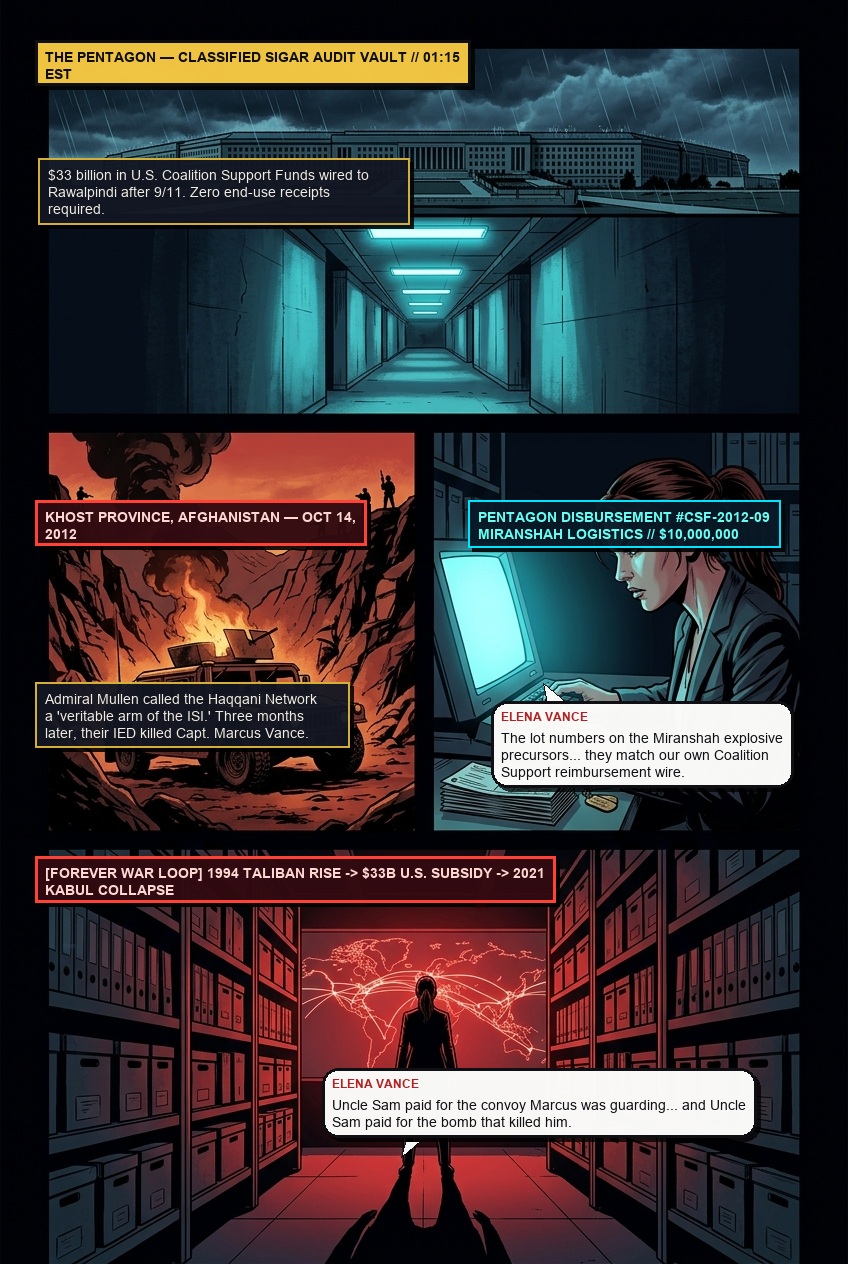
🎨 View This Chapter’s 4-Panel Graphic Novel Page (Page 5 of 16 — CHAPTER 4: THE PUPPET MASTER'S PAYROLL) Click to Expand / Collapse ▼

The dawn over the Potomac was the color of a bruised plum.

Elena Vance stepped off the red-eye at Dulles International at 0530, her trench coat smelling of damp cedar and stale airline coffee. Her body throbbed with the blunt, rhythmic ache of eighty hours without sleep, but her mind was operating with crystalline, adrenalized clarity.

She did not return to her apartment in Arlington. She did not stop at the Treasury Annex.

Instead, she drove her dusty sedan across the Memorial Bridge and pulled into the south parking lot of the Pentagon.

At 0615, the Pentagon was an awakening colossus. Thousands of military personnel and civilian contractors moved in silent, synchronized streams through the metal detectors, badges swinging from nylon lanyards. Elena flashed her inter-agency credentials at the security checkpoint, bypassed the standard escalators, and descended deep into Corridor 8 on the basement level.

Here, behind an eight-inch vault door of reinforced tungsten-carbide steel, lay the subterranean repository of the Special Inspector General for Afghanistan Reconstruction (SIGAR).

The vault was silent save for the low hum of server racks and the dry scent of high-grade toner. Unlike the civilian archives at Suitland, everything here was digital, encrypted under NSA Type-1 cryptographic algorithms, and protected by multi-factor biometric locks. Elena pressed her thumb against the scanner, entered her twenty-four-character Level-5 audit token, and waited as the system authenticated her credential.

The screen blinked green: ACCESS GRANTED — SPECIAL AUDIT OVERRIDE: VANCE, E.

Elena sat at a standalone terminal and pulled Marcus’s dog tag from inside her shirt, holding the cold steel against the palm of her hand.

"Show me the blood money, Marcus," she whispered into the empty SCIF.

She navigated directly to the classified master ledger of the Coalition Support Funds (CSF).

Between October 2001 and December 2020, the United States Congress authorized, and the Pentagon disbursed, $33 billion in Coalition Support Funds to the Pakistani military. Officially, CSF was billed as a "reimbursement mechanism"—repaying Pakistan for the operational costs of deploying over 100,000 troops along the Durand Line, combating Al-Qaeda, maintaining border checkpoints, and securing the critical ground lines of communication that kept NATO forces supplied from Karachi to Torkham.

Elena opened the unredacted SIGAR audit reports compiled between 2008 and 2016—reports that had been classified SECRET / REL TO USA, FEY and permanently withheld from public congressional hearings.

What she read made her stomach turn.

Over seventy percent of the $33 billion in reimbursements had been rubber-stamped by the Pentagon with zero end-use monitoring and zero verified receipts. Pakistani military liaison officers would submit crude, one-page billing vouchers written on carbon paper, claiming tens of millions of dollars for "contingency fuel costs," "wear and tear on combat vehicles," and "air defense radar maintenance."

Elena zoomed in on the audit findings from 2007: The Pakistani military had billed the American taxpayer $19 million for "barbed wire and perimeter fences" along mountain passes where satellite photography revealed only bare rock. They had billed $55 million for "helicopter maintenance" for aircraft that had been grounded in hangars in Rawalpindi for five years. They had billed $200 million for military pensions of officers who had died in the 1970s.

And the Pentagon had paid every single penny.

Why? Because the Defense Department was trapped in a self-inflicted hostage crisis. Seventy-five percent of all fuel, food, ammunition, and heavy equipment needed to sustain 100,000 American troops in Afghanistan had to move on commercial Pakistani flatbed trucks from the port of Karachi, through the Bolan Pass or the Khyber Pass. Every time an American ambassador or general dared to question the fraudulent CSF vouchers, Rawalpindi would orchestrate a "militant ambush" on NATO fuel convoys, or close the Torkham border crossing for "security reviews," leaving American soldiers rationing fuel and ammunition in the mountains.

Washington wasn't paying an ally. Washington was paying protection money to the mafia.

Elena’s hands trembled as she opened the terminal’s cross-referencing search engine. She typed in the date: JUNE 14, 2012.

Location: KHOST PROVINCE, AFGHANISTAN.

Incident Code: RED-DAGGER-77.

The file loaded. A black-and-white satellite map of a dirt supply route outside the town of Sabari appeared on screen, overlaid with red telemetry vectors.

At 0942 local time on June 14, 2012, a four-vehicle patrol from Company B, 1st Battalion, 87th Infantry Regiment, 10th Mountain Division, was ambushed. A high-yield explosively formed penetrator (EFP)—a concave copper disc backed by twenty-five pounds of military-grade C-4—had detonated from a concealed culvert, shearing through the armor of the lead Stryker vehicle like wet cardboard.

Captain Marcus Vance, twenty-eight, died inside the vehicle, his femoral artery severed, drowning in his own blood while his radioman screamed for air support that arrived forty minutes too late.

Elena’s eyes filled with tears, but she blinked them back, her breathing shallow and ragged. She clicked through to the classified forensic bomb-blast analysis conducted by the Joint IED Defeat Organization (JIEDDO).

The copper liner was industrial grade, milled to an exact tolerance of 0.05 millimeters. The trigger mechanism was not a crude cell phone or pressure plate; it was a sophisticated infrared passive sensor manufactured in Europe, utilizing a dual-pulse circuit designed specifically to defeat the Duke V3 electronic countermeasure jammers mounted on American patrol vehicles.

The intelligence summary beneath the report read:

‘Device construction, components, and tactical placement identical to attacks conducted by the Sirajuddin Haqqani Network operating from sanctuary bases in Miramshah, North Waziristan. Informant network confirms attack ordered and directed by Haqqani commander Khalil Al-Rahman, operating under operational coordination with Directorate S liaison officer Major General Asim Bajwa.’

Elena remembered Admiral Mike Mullen’s historic, explosive testimony before the Senate Armed Services Committee in September 2011, just nine months before Marcus died:

“The Haqqani network acts as a veritable arm of Pakistan's Inter-Services Intelligence agency.”

Mullen had spoken the truth on national television. And what had the Obama administration and the Pentagon done in response? They walked back the statement within forty-eight hours, fearful of alienating the Pakistani generals who controlled the Karachi supply routes.

Elena scrolled down to the financial annex of the Khost incident report.

Attached to the file was an intercepted wire transfer ledger declassified by the NSA’s South Asia desk. It tracked the procurement funds used to purchase the infrared triggers and the C-4 explosives from a black-market arms dealer in Quetta.

The purchase order had been paid on May 28, 2012—seventeen days before Marcus was killed.

The total amount was $140,000.

The payment had been drawn from a commercial account at Habib Bank in Miramshah, North Waziristan, under the name of an agricultural trading cooperative: Al-Falah Agro Services.

Elena opened the master Coalition Support Fund disbursement ledger for May 2012.

She tracked the wire serial numbers from the Federal Reserve Bank of New York to the Pakistani Ministry of Defense account in Islamabad.

On May 24, 2012, the Pentagon had disbursed $88 million under CSF Voucher #CSF-2012-PK-088, authorized as "Operational Reimbursement for Counter-Insurgency Operations in North Waziristan."

From that $88 million tranche, exactly $10 million had been transferred on May 26 to the operational slush fund of Directorate S.

From that $10 million, an internal Pakistani inter-bank transfer had moved $500,000 to Al-Falah Agro Services at the Habib Bank branch in Miramshah.

And from Al-Falah Agro Services, $140,000 was withdrawn in cash on May 28 to buy the explosive switches that tore her brother’s body to pieces.

The screen blurred. Elena leaned her forehead against the edge of the plastic monitor casing, her chest heaving in dry, agonizing sobs.

It wasn't an accident. It wasn't a tragedy of war.

The bomb that killed Marcus hadn't been bought with Taliban opium money or private donations from Gulf sheikhs.

It had been paid for with American taxpayer dollars, disbursed by the Pentagon, signed off by desk officers in Arlington, and transferred through the Federal Reserve Bank of New York.

Uncle Sam had paid for both sides of the war.

Washington had paid American soldiers to patrol the dusty roads of Khost, and Washington had paid the Pakistani generals who supplied the Haqqanis with the bombs to blow those soldiers into meat.

Elena pulled her head up. Her tears had dried, leaving behind a cold, burning diamond of pure hatred.

She traced the rest of the historical timeline forward, watching the grand, cynical farce unfold across three decades.

The genesis in 1994, when Benazir Bhutto’s interior minister, Major General Naseerullah Babar, provided $10 million in covert seed money and military advisers to create the Taliban out of the Deobandi refugee madrassas of Quetta and Peshawar, dubbing them "our boys."

The October 1996 capture of Kabul, when Pakistani regular soldiers operated the heavy artillery that pulverized the Afghan capital.

The post-9/11 "double game" perfected by General Pervez Musharraf—arresting mid-level Arab Al-Qaeda operatives whenever Washington demanded results, while providing secure villas and armed escorts for the Afghan Taliban’s Quetta Shura and the Haqqani leadership.

And the final, grotesque betrayal: The February 2020 Doha Agreement, negotiated by U.S. envoy Zalmay Khalilzad and Arthur Pendelton.

Elena opened the confidential briefing memos attached to the Doha deal. Washington had deliberately excluded the sovereign Afghan government from the negotiations, agreeing to release 5,000 hardened Taliban fighters from Bagram and Pul-e-Charkhi prisons.

And on August 15, 2021, as Kabul collapsed and desperate Afghans fell from the wheel wells of retreating American C-17s, who had flown into Kabul to manage the victory?

The Director General of the ISI, Lieutenant General Faiz Hameed, photographed sipping green tea in the lobby of the Serena Hotel, smiling calmly into the cameras as he declared: "Don't worry, everything will be okay."

Of course it was okay. The client had won. The investment had matured.

Elena plugged her encrypted drive into the terminal and began downloading every voucher, every wire serial number, every satellite analysis of Sabari, and every signature authorizing CSF Voucher #CSF-2012-PK-088.

At the bottom of the 2012 authorization chit, scrawled in black felt-tip marker next to the Pentagon comptroller’s stamp, sat the approval initials of the National Security Council’s senior director for South Asia:

A.P.

Arthur Pendelton.

Elena stared at the initials. Her hands were no longer shaking.

"You signed the check, Artie," she whispered, watching the progress bar on her flash drive reach 100 percent. "You signed the check that killed my brother. And now, I’m going to balance the ledger."

Act II • The Call From Inside the House • Chapter 5 The Potomac Ledger • A Thriller by Anand Dubey

Blood and Minerals in Balochistan

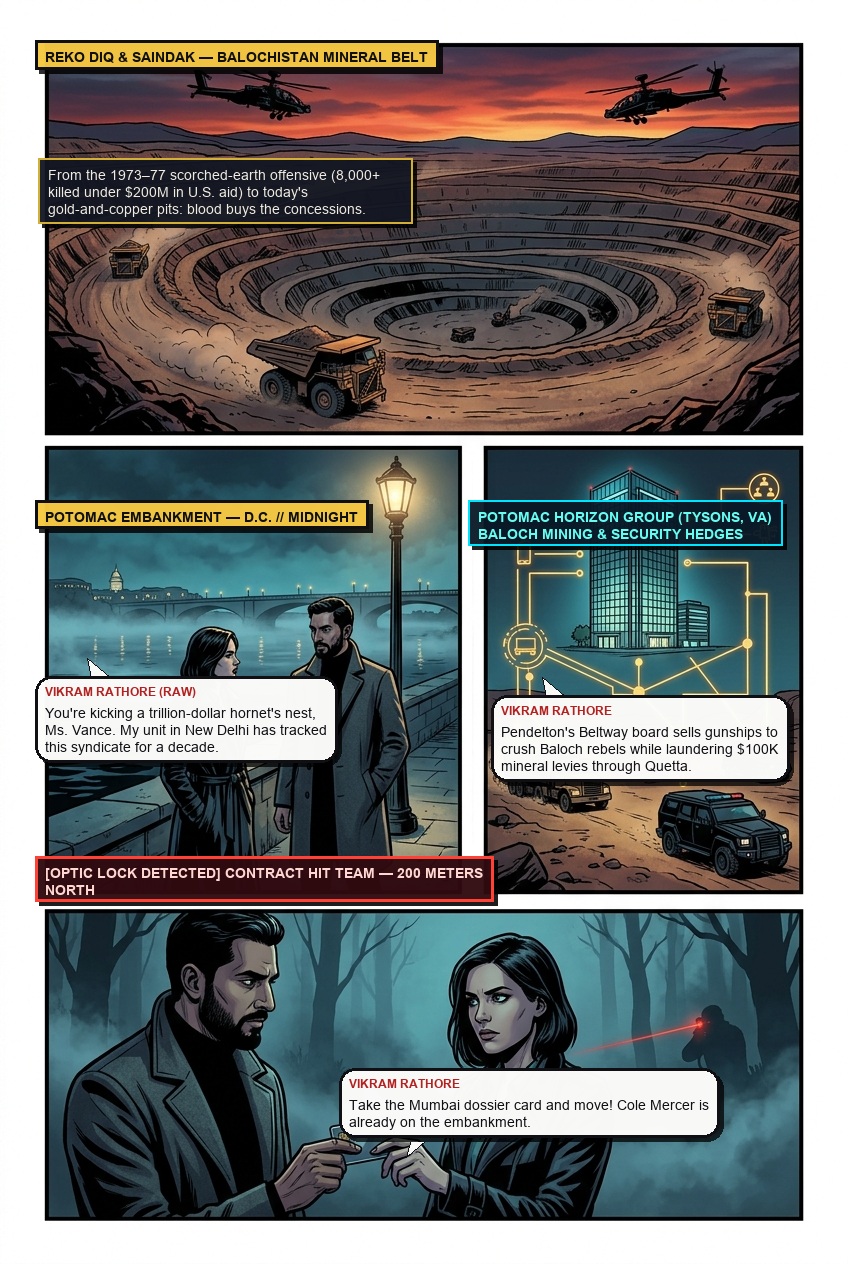
🎨 View This Chapter’s 4-Panel Graphic Novel Page (Page 6 of 16 — CHAPTER 5: BLOOD AND MINERALS IN BALOCHISTAN) Click to Expand / Collapse ▼

The heat in Washington had turned stagnant, wrapping the city in a wet, suffocating blanket of August air.

Elena Vance walked along the brick towpath of the C&O Canal in Georgetown, the murky water reflecting the yellow glow of wrought-iron gas lamps. Her back prickled with the instinctual paranoia of an investigator who knew she had crossed the rubicon. Every jogger wearing earbuds, every black government-plated Tahoe idling along M Street, felt like a spotter for Cole Mercer.

She checked her encrypted burner phone. A single message had arrived via an air-gapped Signal relay:

CANAL LOCK 4. BENCH OPPOSITE THE OLD MILL. 2130.

Elena had spent the afternoon following the second stream of the Islamabad liquidity drain: a $100,000 peer-to-peer crypto remittance that had originated from an over-the-counter desk in Quetta, hopped through a money-services broker in Chaman on the Afghan border, and settled in a private wealth management trust in Mayfair, London.

The account in London belonged to a shell firm called Chagai Mineral Holdings Ltd.

Beneath the shell firm lay the bleeding, scorched-earth reality of Balochistan.

Elena reached Lock 4. The wooden gates of the historic canal were dark, water trickling between rotting timber.

Sitting on a green slatted wooden bench beneath an ancient weeping willow was a man wearing an unstructured linen jacket over a dark t-shirt. He was forty-two, with close-cropped salt-and-pepper hair, sharp bronze cheekbones, and dark, watchful eyes that surveyed the towpath with the relaxed alertness of an apex predator. A silver thermos of masala chai rested on the bench beside him.

"You walk like a woman who expects an incoming mortar round, Vance," the man said in a low, cultivated voice, speaking with the clipped, elegant cadence of St. Stephen’s College and the intelligence war rooms of New Delhi.

"I walk like a woman who just realized her boss financed the IED that killed her brother," Elena said, stopping five feet from the bench, keeping her hands visible. "Vikram Rathore?"

"Consular Counselor for Economic Affairs at the Embassy of India," he said, offering a tight, humorless smile. "Or so my diplomatic credentials tell the State Department. Sit down, Elena. The tea is fresh. Ginger and green cardamom. Better than that battery acid they brew in the Treasury cafeteria."

Elena sat on the far edge of the bench, declining the chai. "How did you find the Chaman crypto hop?"

"We didn't find it; we've been watching it for seven years," Rathore said, pouring a small splash of amber tea into the thermos lid. "My desk at the Research and Analysis Wing has been tracking Directorate S's Balochistan slush fund since the first blast at Gwadar. You Americans think you discovered terrorism in 2001. For us, the bleed has been seven decades of daily reality."

Rathore opened an unbranded leather satchel and pulled out a thick dossier wrapped in black linen. He laid it between them on the bench.

"You looked into Chagai Mineral Holdings," Rathore said. "What did your algorithms tell you?"

"A $100,000 monthly disbursement disguised as 'tribal security levies' and heavy machinery leases," Elena replied. "Paid out to local paramilitary auxiliary commanders operating under the Frontier Corps. But the cash comes from mining royalties."

"Reko Diq," Rathore nodded grimly. "In the Chagai district of western Balochistan. One of the largest undeveloped copper-gold deposits on the planet. Over five billion tons of ore. Fifty billion pounds of copper, thirteen million ounces of gold. A conservative valuation of over one hundred billion dollars. And fifty miles north sit the Saindak open-pit copper mines, leased out to Chinese state conglomerates for twenty years while the local Baloch population drinks contaminated groundwater and dies of typhoid."

Rathore turned a page in the dossier, revealing black-and-white photographs of mass graves in the desert.

"Balochistan is the grand tragedy that Western newspapers never print," Rathore said softly. "It began in March 1948, when the newly formed Pakistani state invaded the independent Khanate of Kalat, forcing its accession at the point of a bayonet. In 1958, when the venerable Nawab Nauroz Khan led an uprising for provincial autonomy, the Pakistani army sent emissaries carrying the Holy Quran, swearing on their sacred book that if the Baloch fighters laid down their arms, they would be granted safe passage and a general amnesty."

Elena looked at Rathore. "What happened?"

"Nauroz Khan believed them," Rathore said, his voice tightening. "He ordered his men to surrender. The Pakistani army immediately arrested him, dragged his sons and nephews to the gallows in Hyderabad and Sukkur, and hanged them all. Nauroz Khan died in a prison cell at the age of eighty-six. That is the honor of the Pakistani General Staff."

Rathore turned to the next section of the file, dated 1973 to 1977.

"When the province rose again in the 1970s demanding democratic rights, Prime Minister Zulfikar Ali Bhutto deployed 80,000 troops and launched a scorched-earth campaign across the Marri and Mengal tribal belts," Rathore continued. "Over eight thousand Baloch civilians and fighters were butchered. And who paid for the slaughter, Elena?"

Elena didn't need to guess. The pattern was already etched into her memory.

"Gerald Ford," she said.

"President Gerald Ford and Henry Kissinger," Rathore confirmed, tapping a declassified National Security Council memo. "Washington provided over $200 million in emergency military and economic credits to Islamabad between 1974 and 1976. That aid included Bell AH-1 Huey Cobra attack helicopters and C-130 transport aircraft. Those American-supplied gunships, piloted by Pakistani and Iranian air force officers, rained napalm and heavy ordnance down on defenseless nomadic encampments in the Kohlu mountains. Washington wanted an unsinkable Cold War aircraft carrier on the Indian Ocean, and they didn't care if it was built on a foundation of Baloch bones."

Elena flipped through the modern sections of the file. The pages were filled with horrifying casualty lists: young students, doctors, poets, and human rights lawyers abducted from their homes by unmarked white Toyota double-cabin pickups.

"The 'kill-and-dump' policy," Elena noted, recognizing the intelligence terminology.

"Over twenty thousand enforced disappearances in the last fifteen years alone," Rathore said. "Their bodies turn up months later dumped in roadside ditches outside Quetta and Khuzdar, their eyes gouged out, drills driven through their skulls, cigarettes extinguished on their chests. And to counter the secular Baloch nationalist movement, Directorate S did what it always does: they created religious monsters."

Rathore leaned forward, his dark eyes boring into hers.

"When secular students protested against the Chinese takeover of Gwadar, the Pakistani military sponsored sectarian death squads. They funded Lashkar-e-Jhangvi and protected ISIS-Khorasan outposts in Mastung. They unleashed fanatical Sunni extremists to slaughter Baloch dissidents and wipe out the Hazara Shia minority. It is the exact same playbook they used in Kashmir with Lashkar-e-Taiba, and in Afghanistan with the Taliban: weaponize religious fanatics to crush local sovereignty, and bill Washington for the cleanup."

"And where does Arthur Pendelton fit into this?" Elena asked, leaning closer. "The $100,000 crypto trail in Quetta cleared through a Delaware trust called Potomac Horizon."

Rathore let out a dry, bitter laugh.

"Arthur Pendelton is the ultimate beneficiary, my dear Elena. Potomac Horizon Group doesn't just lobby for military aid in Washington. They are the risk-insurance underwriter and private security broker for the Western and Canadian mining consortiums operating in Balochistan. When Barrick Gold restructured the Reko Diq project, Potomac Horizon secured the classified risk-guarantee contracts with the Overseas Private Investment Corporation. And who provides the physical ground security for the copper-gold extraction convoys moving from Chagai to the coast?"

Elena’s eyes widened as the realization struck her. "The Frontier Works Organisation. The Pakistani military."

"Precisely," Rathore said. "The Pakistani military gets the mineral concessions and the American weapons. Potomac Horizon gets a two-percent gross royalty on all exported concentrate and millions in consultancy fees deposited into their private accounts at Potomac Horizon Bank in Reston. And Pendelton ensures that every human rights report on Balochistan submitted to the State Department is classified, buried, or stripped of teeth."

Rathore closed the black linen folder and pushed it into Elena’s hands.

"They are profiting from both sides of the slaughter, Elena. They finance the army that carries out the disappearances, they take equity in the minerals extracted from the stolen land, and they sell the security systems to protect the mines from the bereaved sons of the men they murdered."

Elena clutched the heavy dossier against her chest. The C&O Canal was silent, the dark water drifting slowly toward the Potomac.

"Pendelton assigned me to write an audit," Elena said, her voice steady as iron. "He thought I would write a diplomatic fiction. He thought my brother’s death would make me blind to everything except raw hatred for Rawalpindi."

"Pendelton miscalculated," Rathore said, rising from the bench and picking up his thermos. "He forgot that grief is a fire that can burn in any direction. But you need to understand something, Elena. You are no longer investigating a rogue agency in Pakistan. You are investigating the shadow treasury of the American empire. They will not subpoena you. They will not demote you. They will kill you."

"Cole Mercer," Elena said.

Rathore paused, his eyes narrowing in the darkness.

"Mercer is already in town," Rathore whispered. "He arrived at Dulles on a private charter from Dubai three hours ago. Watch your back, Elena. And tell that brilliant boy in your basement to stop querying the Reston clearing accounts before they pull the plug on his oxygen."

Rathore turned and melted into the shadows of the towpath, leaving Elena alone under the swaying willow, holding the blood-stained ledger of Balochistan.

Act II • The Call From Inside the House • Chapter 6 The Potomac Ledger • A Thriller by Anand Dubey

The Taj Protocol

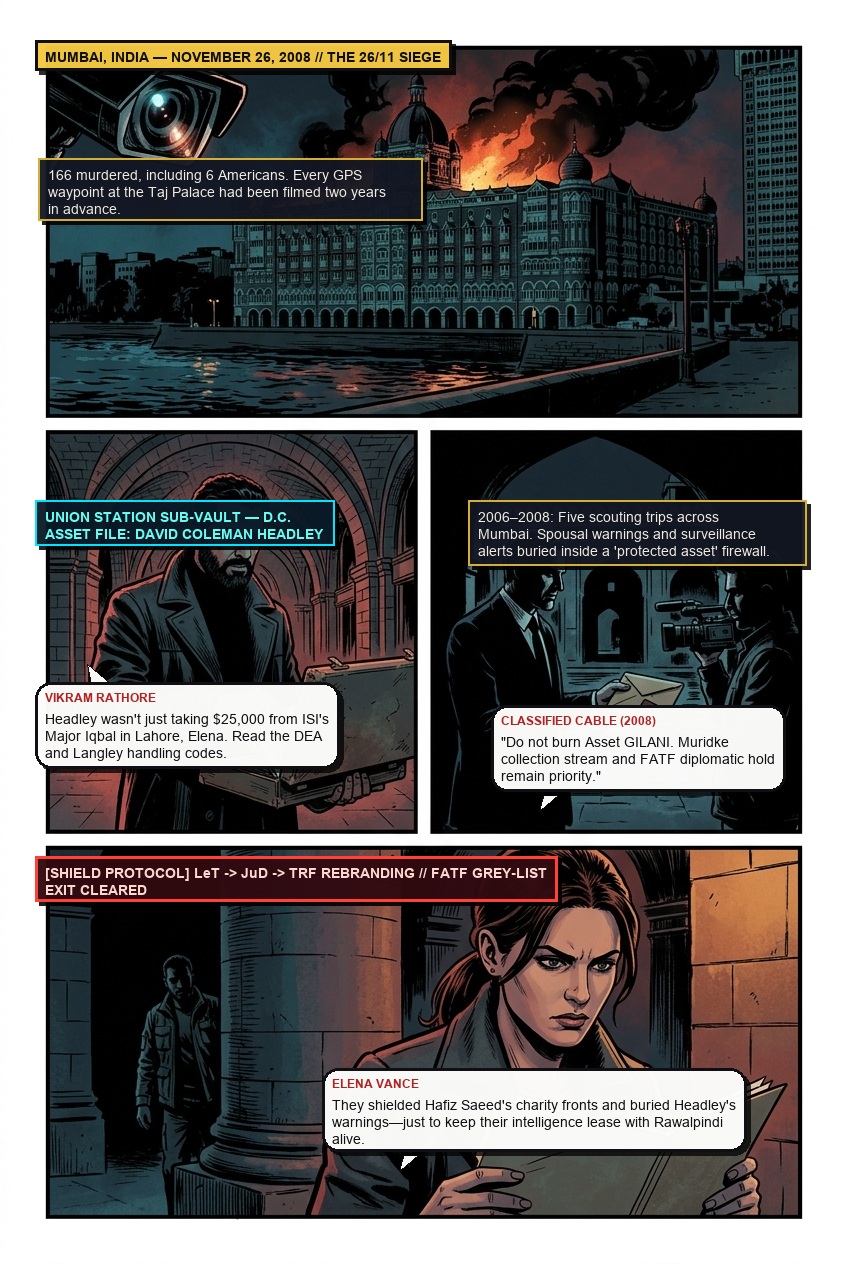
🎨 View This Chapter’s 4-Panel Graphic Novel Page (Page 7 of 16 — CHAPTER 6: THE TAJ PROTOCOL) Click to Expand / Collapse ▼

The subterranean baggage corridors beneath Washington’s Union Station were carved out of century-old concrete, brick, and raw bedrock.

At midnight, the concourse above was shuttered, but twenty feet below the tracks, the ground hummed with the heavy, rhythmic vibration of idling Amtrak locomotives and long-distance freight trains pushing south toward Richmond. Steam hissed from exposed iron pressure valves, wreathing the yellow safety cages and damp walls in a pale, spectral fog.

Elena Vance leaned against a concrete support pillar near Track 12, her breath shallow, her right hand resting firmly on the grip of her Glock.

A metal service door clicked open thirty yards down the maintenance catwalk.

Vikram Rathore stepped through the steam. He had discarded his linen jacket for a dark canvas work coat and a knit watch cap, looking indistinguishable from the overnight transit maintenance crews. In his left hand, he carried a heavy, expanding legal folder sealed with red tamper-evident wax and stamped with faded classification headers: TOP SECRET / ORCON / NOFORN / DEA-SPECIAL-PROJECTS.

"You were followed from Georgetown," Rathore said without greeting, stopping four paces away in the echoing corridor. "A dark grey sedan with Virginia diplomatic plates tailed you onto Massachusetts Avenue."

"I took the pedestrian escalators down to the Red Line, doubled back through the lower utility tunnels, and came up behind the baggage carousel," Elena said, her pulse settling. "I shook them."

"You delayed them," Rathore corrected softly, his eyes scanning the catwalk behind her. "Mercer’s contractors have the D.C. Metropolitan Police traffic-camera feed mirrored on their field tablets. The perimeter is shrinking, Elena."

He stepped forward and thrust the heavy folder into her hands. The cardboard was worn, creased at the edges, and felt dense as a brick.

"What is this?" Elena asked.

"The original sin of the modern war on terror," Rathore said. "The unredacted asset file on David Coleman Headley."

Elena looked down at the file, her chest tightening. "Headley. Born Daood Sayed Gilani. The Mumbai reconnaissance scout."

"Open it," Rathore commanded. "Read the dates. Read the agency codes. Don't look at the press clippings; look at the federal handling logs."

Elena untied the linen string, broke the red wax seal, and opened the dossier under the harsh glare of an overhead halogen bulb.

The opening pages documented a career criminal. Born in Washington, D.C., in 1960 to a high-ranking Pakistani diplomat and an American socialite, Headley grew up in Pakistan, attended the prestigious Cadet College Hasan Abdal, and later moved to Philadelphia. In 1988, he was arrested by the Drug Enforcement Administration at Frankfurt airport attempting to smuggle two kilos of high-purity Pakistani heroin. Facing a decade in federal prison, Headley did what he would do for the rest of his life: he turned state’s evidence, traded his partners, and signed on as a confidential DEA informant.

In 1997, he was arrested again in New York with another kilo of heroin. Instead of receiving a mandatory life sentence under three-strikes statutes, federal prosecutors in Brooklyn intervened. His sentence was reduced to fifteen months, followed by immediate reinstatement as a prized federal asset.

Elena flipped the page. Her eyes widened as she reached the year 2001.

"Look at the handling logs," Rathore said, his voice dropping into a harsh, furious whisper. "October 2001. Just weeks after the World Trade Center towers fell, Headley’s former domestic partner walked into the DEA’s New York field office. She told federal agents that Headley was passionately celebrating the attacks, that he was traveling back and forth to Pakistan, and that he had actively joined Lashkar-e-Taiba—the lethal proxy militia created by Pakistani military intelligence to wage jihad against India."

"What did the DEA do?" Elena asked, tracing the typed entries.

"They did nothing," Rathore said. "They kept him on the federal payroll. In 2002, they officially deactivated him on paper while transferring his handler custody to a joint inter-agency liaison desk inside the CIA’s Special Operations Group."

Elena turned to 2005. The documents were sickening in their detail.

In August 2005, Headley’s second wife, an American woman, contacted the FBI’s Joint Terrorism Task Force in New York. Over three separate interviews, she detailed how Headley had spent months at Lashkar-e-Taiba’s sprawling forty-acre headquarters in Muridke, outside Lahore. She warned agents that he was receiving advanced guerilla warfare training, learning small-unit tactics, and bragging that he was preparing a major terrorist strike against India.

And in December 2007, his third wife, a Moroccan national named Faiza Outalha, walked into the U.S. Embassy in Islamabad. She sat across from an American regional security officer and explicitly stated that her husband was a Lashkar operative, that he was staying at the iconic Taj Mahal Palace Hotel in Mumbai, and that he was scouting the building for an imminent, catastrophic assault.

Elena looked up from the paper, her breath catching in her throat. "Three separate family members walked into federal law enforcement offices and named the target. The Taj Mahal Palace Hotel. In 2007. A full year before the attack."

"And what did Washington do with Faiza Outalha’s testimony?" Rathore asked, his jaw clenching so hard the muscles jumped in his cheek. "They closed the inquiry. They did not enter Headley’s name onto the federal No-Fly list. They did not notify Indian security agencies. They did not even place a basic border-alert flag in the Treasury’s financial surveillance network."

"Why?" Elena’s voice was barely a whisper against the rumble of the train above. "Why protect him?"

Rathore pointed at a heavily classified memorandum tucked into the center of the folder, bearing the operational header: PROJECT TAJ PROTOCOL / LANGLEY-DO-NEAR-EAST.

"Because Arthur Pendelton and the CIA’s Near East Division were running a covert unilateral penetration operation," Rathore said, the disgust dripping from every word. "After 9/11, Washington was desperate to penetrate Al-Qaeda’s central leadership in the Federally Administered Tribal Areas. Langley believed that Lashkar-e-Taiba was the golden key—the ideological and logistics bridge connecting Pakistani military intelligence to Osama bin Laden’s inner circle in Waziristan. Headley had blue eyes, an American passport, and impeccable English, while holding an elite lineage in Pakistan. He was the perfect asset to penetrate Lashkar’s high command in Muridke."

Elena read the operational entries, her stomach churning.

Between 2006 and 2008, David Coleman Headley made five extensive reconnaissance trips to Mumbai. He changed his birth name from Daood Gilani in a Philadelphia court to obscure his Muslim identity. He opened a bogus immigration consultancy office in Mumbai as a commercial cover. He took boat tours around Mumbai harbor, using a handheld GPS receiver to mark the precise landing site at Badhwar Park. He stayed at the Taj Mahal Palace Hotel, filming every emergency staircase, kitchen delivery corridor, and ballroom fire exit. He videotaped the Oberoi Trident, the Chhatrapati Shivaji Terminus railway station, Leopold Cafe, and the Nariman House Jewish community center.

And who financed the surveillance?

Elena read the financial annex: Exactly $50,000 in cash and high-denomination counterfeit Indian currency was handed to Headley in Lahore by his primary handler: "Major Iqbal," an active-duty intelligence officer in Directorate S of the ISI.

"Fifty thousand dollars," Elena whispered. "From an ISI major. While U.S. intelligence tracked his satellite phone."

"They had his phone," Rathore confirmed with lethal precision. "They had his emails. The NSA was intercepting Headley’s communications with his Lashkar handlers, Sajid Mir and Zaki-ur-Rehman Lakhvi. Washington issued vague, generic warnings to New Delhi that 'hotels near the Mumbai waterfront might be targeted.' But they never gave us Headley’s name. They never shared the video blueprints. They never told us that an American citizen holding a DEA badge was pacing the halls of the Taj with a camcorder."

Elena closed her eyes as the horror washed over her.

November 26, 2008.

Ten heavily armed Lashkar-e-Taiba fidayeen commandos sailed into Mumbai harbor on an inflatable Zodiac boat, guided by the GPS coordinates Headley had marked. For sixty hours, they unleashed hell on a defenseless city.

One hundred and sixty-six innocent people—hotel guests, railway commuters, police officers, rabbis, children—were slaughtered.

Six American citizens were murdered among the dead.

"Six Americans died in the Taj, Vikram," Elena said, her voice shaking with outrage. "Our own citizens."

"To Pendelton and his syndicate, those six Americans were just operational overhead," Rathore said coldly. "Collateral damage required to protect their prized asset and preserve their covert relationship with the Pakistani military high command. Even after Mumbai burned, Headley was allowed to travel back to Chicago, fly to Denmark to scout a second terrorist attack on a newspaper office, and walk through O’Hare airport before the FBI finally arrested him in October 2009—only because the British intelligence service, MI5, threatened to leak his asset file if Washington didn't take him off the street."

Rathore tapped the final section of the dossier: the diplomatic cables.

"And look at how they protected the masterminds," Rathore added. "For sixteen years, Hafiz Saeed, the supreme chief of Lashkar-e-Taiba, lived openly in a fortified villa in Lahore, holding mass public rallies, appearing on prime-time television, and collecting hundreds of millions in donations through his charity fronts, Jamaat-ud-Dawa and Falah-e-Insaniat Foundation. Whenever India pressed the Financial Action Task Force to place Pakistan on the FATF blacklist—which would have severed Rawalpindi’s access to the IMF and World Bank—Washington intervened behind the scenes. They watered down the resolutions. They kept Pakistan on the 'grey list' just long enough to extract diplomatic concessions, then lobbied to remove them."

"And when Lashkar rebranded?" Elena asked.

"They birthed The Resistance Front," Rathore said. "TRF. Same fighters, same ISI payroll, same safe houses, but marketed with a secularized acronym to give Western diplomats plausible deniability. And through it all, Potomac Horizon’s banking channels in Virginia kept clearing the liquidity."

A sudden high-pitched chime echoed down the maintenance catwalk.

Elena’s phone was vibrating violently inside her pocket. She pulled it out.

It was Liam Chen. The call was coming over a burn-on-read Signal channel, bypassing the Treasury proxy servers.

"Liam?" Elena answered, pressing the phone to her ear.

"Elena! Where the hell are you?" Liam’s voice was frantic, breathless, bordering on total hysteria. Background subway noise roared through the speaker. "Get out of the Treasury! Get away from any federal building right now!"

"Liam, calm down. What happened?"

"I cracked the Pulwama ledger, Elena!" Liam gasped, his words tumbling over each other. "The $500,000 Dubai hawala transfer that paid for the 2019 suicide bombing in Kashmir... it didn't clear through Karachi! It cleared through a domestic correspondent account in Northern Virginia! I have the signed authorization slips! Arthur Pendelton’s signature is on the liquidity release!"

Elena felt the floor tilt beneath her feet. "Liam, where are you?"

"I’m at the Rosslyn Metro station!" Liam yelled over the screech of train brakes. "Lower level. Orange Line platform. I downloaded the raw cryptographic keys onto a portable SSD! Mercer’s people are in the station, Elena! I saw them on the upper mezzanine! You have to come now!"

The line cut out with a burst of electromagnetic static.

Elena looked up at Vikram Rathore, her eyes wide with terror.

"They’re going to kill him," Elena whispered.

"Rosslyn," Rathore said, his hand already reaching for the concealed weapon inside his coat. "Run, Elena. If Mercer takes that drive, the truth dies tonight."

Act II • The Call From Inside the House • Chapter 7 The Potomac Ledger • A Thriller by Anand Dubey

Flight 814 and the Bahawalpur Shield

🎨 View This Chapter’s 4-Panel Graphic Novel Page (Page 8 of 16 — CHAPTER 7: FLIGHT 814 & THE BAHAWALPUR SHIELD) Click to Expand / Collapse ▼

Elena Vance drove like a woman outrunning an artillery barrage.

Her unmarked government sedan tore across the Key Bridge, the dark, swollen waters of the Potomac churning forty feet below. The illuminated skyline of Georgetown vanished in her rearview mirror as she hit the Virginia shoreline, tires screaming across the wet expansion joints of Fort Myer Drive.

Her phone lay face-up on the passenger seat, Liam Chen’s frantic final words echoing through her skull like a death sentence:

“I cracked the Pulwama ledger... It cleared through a domestic correspondent account in Northern Virginia... Arthur Pendelton’s signature is on the liquidity release... Rosslyn Metro, lower level... Mercer is in the station...”

The historical architecture behind Liam’s discovery was a labyrinth of American complicity that stretched back a quarter of a century.

Elena knew the file by heart. On December 24, 1999, Indian Airlines Flight IC-814, carrying 176 passengers and crew from Kathmandu to Delhi, was hijacked by five Harkat-ul-Mujahideen operatives armed with knives, pistols, and hand grenades. After refueling stops in Amritsar, Lahore, and Dubai, the hijackers forced the Airbus A300 down on the dusty tarmac of Kandahar, Afghanistan—the heart of the Taliban’s Islamic Emirate.

For seven agonizing days on that freezing tarmac, as passengers starved and hostage Rupin Katyal was brutally stabbed to death in seat 17B, the Pakistani military high command and Taliban foreign minister Wakil Ahmad Muttawakil orchestrated the standoff. And what had Washington done?

President Bill Clinton’s administration, desperate to avoid a broader regional war and reluctant to alienate General Pervez Musharraf—who had seized power in a military coup in Islamabad only two months earlier—refused to intervene or authorize a rescue operation. Under intolerable pressure, the Indian government had been forced to trade three high-value terrorists for the innocent hostages.

One of those released terrorists was a rotund, fanatical Deobandi cleric named Maulana Masood Azhar.

Escorted by Pakistani intelligence officers across the Durand Line to Quetta, Azhar did not hide in the mountains. Within weeks, he held a massive press conference at the Karachi Press Club, surrounded by armed bodyguards and Pakistani intelligence liaisons, and announced the formation of Jaish-e-Mohammed—the "Army of Muhammad."

With millions of dollars in state patronage, Azhar built a sprawling, ten-acre fortress in the desert city of Bahawalpur in southern Punjab: Markaz Subhanallah. The complex featured swimming pools, obstacle courses, advanced firing ranges, and subterranean auditoriums where tens of thousands of young boys were indoctrinated into jihad.

From Bahawalpur, Jaish-e-Mohammed launched a twenty-year campaign of industrial slaughter: the December 2001 suicide assault on the Indian Parliament in New Delhi that brought a million mobilized troops to the border; the 2016 commando raid on the Pathankot Indian Air Force base; and the cataclysm of February 14, 2019.

Pulwama.

A nineteen-year-old suicide bomber named Adil Ahmad Dar rammed an explosive-laden vehicle packed with three hundred kilograms of military-grade RDX into a seventy-six-vehicle convoy of the Central Reserve Police Force along the Jammu-Srinagar Highway. Forty Indian soldiers were vaporized in a fraction of a second, their body parts scattered across half a mile of orchards.

Every intelligence service in the world knew Jaish-e-Mohammed was responsible. India launched retaliatory airstrikes on Jaish’s primary training camp in Balakot, Pakistan.

And for six years, Western counterterrorism analysts had assumed the $500,000 required to procure the RDX, purchase the vehicle, and pay off local informants had been moved through traditional Middle Eastern hawala networks operating between Dubai and Karachi.

They were wrong.

Liam Chen had just found the real correspondent clearinghouse. The $500,000 hadn't originated in a Gulf sovereign fund. It had cleared through Potomac Horizon Bank & Trust in Reston, Virginia—an offshore banking facility chartered under a classified CIA national security exemption, co-signed by Deputy National Security Advisor Arthur Pendelton.

Masood Azhar’s Bahawalpur shield wasn't just built by Pakistani generals. It was underwritten by Northern Virginia venture capital.


Elena slammed the brakes, the sedan skidding into the passenger drop-off lane outside the Rosslyn Metro station in Arlington.

Rosslyn was a subterranean concrete cavern, one of the deepest stations in the entire Washington transit system, descending over one hundred feet beneath the Virginia bedrock.

Elena pushed through the glass turnstiles, flashing her FinCEN badge at a bewildered transit attendant who barely had time to look up before she vanished into the gloom.

She reached the top of the monumental central escalator.

The moving staircase stretched downward at a dizzying thirty-degree angle for two hundred and seven continuous feet, disappearing into the fluorescent gloom of the lower mezzanine. The ride down took nearly three minutes.

Elena didn't ride. She ran.

Her boots hammered against the grooved steel treads, her hand holding her Glock beneath her coat as she vaulted past late-night commuters clutching briefcases and umbrellas.

"Out of the way! Federal agent! Move!" she shouted.

Her lungs burned with cold, recycled air. She cleared the bottom of the escalator, hit the intermediate mezzanine, and sprinted down the final concrete staircase to the lower platform: the westbound Orange and Silver Lines heading toward Vienna and Dulles.

The platform was nearly empty, illuminated by harsh white tube lighting that cast long, angular shadows against the ribbed concrete vaults.

At the far end of the platform, standing near the safety edge beneath a digital countdown clock that read TRAIN 1 MIN, stood Liam Chen.

He looked terrified, shivering uncontrollably inside an oversized hooded fleece jacket. In his right hand, he clutched a ruggedized, matte-black Samsung external SSD drive wrapped in electrical tape.

And ten paces behind him, moving with the silent, predatory grace of an apex hunter, was Cole Mercer.

Mercer was thirty-nine, broad-shouldered, wearing an unbranded slate-grey Arc’teryx jacket, dark tactical trousers, and a black baseball cap pulled low over cold, dead eyes. He had spent eight years in JSOC’s Special Activities Division before becoming Pendelton’s personal cleaner. He walked without making a sound, his posture completely relaxed, his hands buried deep in his jacket pockets.

"Liam!" Elena screamed, her voice echoing off the concrete vaulted ceiling like a gunshot. "Behind you! Liam, run!"

Liam spun around, his eyes going wide with pure, paralyzing terror.

Mercer didn't draw a gun. A firearm would draw transit cameras and trigger acoustic gunshot detection sensors.

He closed the distance in two explosive strides.

With clinical, terrifying precision, Mercer’s right hand whipped out of his pocket, striking the side of Liam’s neck with an open-palm brachial stun that shattered the young analyst’s equilibrium. In the same fluid motion, Mercer’s left hand gripped Liam’s shoulder, driving his knee into Liam’s spine, and hurled him over the platform edge.

Down on the tracks, the steel rails began to hum violently with approaching current.

A high-beam headlight flared at the mouth of the tunnel as an eight-car, eight-hundred-ton transit train burst into the station at forty miles per hour, its air horns blaring in frantic, deafening blasts.

"No!" Elena shrieked, sprinting forward, drawing her weapon.

Liam fell heavily into the track bed. His outstretched hand hit the heavy, ceramic-shrouded third rail—carrying seven hundred and fifty volts of direct electrical current.

A blinding blue-white arc flash detonated in the trench.

A horrific crackle like tearing canvas filled the cavern, followed instantly by the sickening smell of ozone, scorched meat, and burning insulation. Liam’s body arched violently as tens of thousands of watts surged through his heart, killing him before his back hit the gravel. A microsecond later, the massive steel wheels of the lead train car crushed over him, obliterating what remained in a shower of sparks and metal screeching against iron.

The screams of three women on the platform tore through the roar of the braking train.

In the blinding chaos and electrical smoke, Elena saw the black SSD drive.

As Mercer had struck him, Liam had hurled the drive with his dying strength. It had skittered across the concrete platform edge, spinning toward the middle bench.

Elena dove across the concrete, her shoulder slamming into the tiled floor, her hand closing tightly around the drive.

Across the tracks, through the gaps between the decelerating train cars, Cole Mercer stopped.

Through the windows of the passing train, their eyes locked.

Mercer’s expression didn't contain anger, or surprise, or remorse. It was completely empty. The face of an executioner checking off an administrative task.

Slowly, deliberately, Mercer’s right hand went inside his Arc’teryx jacket. He drew a custom SIG Sauer P320 fitted with a fat carbon-fiber suppressor.

Pfft. Pfft.

Two subsonic 9mm rounds punched into the concrete pillar six inches above Elena’s head, spraying pulverized plaster and stone dust across her cheek.

"Active shooter!" a man screamed. Commuters dropped to the floor, crawling behind concrete trash bins and metal advertising boards in blind panic.

Elena rolled behind the structural pillar, her Glock clearing leather. She leaned out and fired three rapid rounds across the tracks.

Crack! Crack! Crack!

The unsuppressed 9mm rounds boomed like thunder in the enclosed cavern. One round struck the steel door of the train car; the second ricocheted off a tiled column near Mercer’s shoulder; the third sent Mercer ducking behind an emergency call box.

Elena didn't stay to trade fire. She had the drive.

She turned and sprinted toward the ascending escalators.

Behind her, she heard the heavy, relentless rhythm of Mercer’s boots pounding up the concrete stairs two at a time. He was taking the maintenance access route to cut her off at the upper mezzanine.

Elena hit the two-hundred-and-seven-foot escalator. It was moving downward.

She climbed against the descending steel treads with feral, adrenalized fury. Her legs screamed with lactic acid, her chest heaving as if breathing broken glass. Ten steps. Twenty steps. Fifty steps. Every muscle in her body burned.

Halfway up the incline, she looked back.

Mercer had cleared the lower platform and was sprinting up the adjacent maintenance stairs, his suppressed pistol tucked against his ribcage, closing the vertical gap with horrifying speed.

Elena reached the top mezzanine, her hands slick with sweat. She burst through the glass emergency exit doors, setting off a piercing electronic alarm that wailed through the upper concourse.

She didn't take the street exit where Mercer’s spotters would be waiting in black SUVs. She kicked open a heavy fire door marked TRANSIT PERSONNEL ONLY — PARKING DECK CONNECT and lunged into the concrete stairwell.

She took the stairs four at a time, bursting onto Level 2 of the adjacent commercial parking garage.

The garage was dimly lit, rows of parked commuter cars sleeping beneath rows of yellow fluorescent tubes. Her unmarked sedan was parked seventy yards away on Level 1.

Behind her, the heavy steel fire door was kicked off its latch with a deafening bang.

Elena scrambled behind a massive concrete support pillar just as two suppressed rounds shattered the rear windshield of a parked silver Camry beside her. Glass rained onto the concrete.

"Vance!" Mercer’s voice echoed through the garage, calm, conversational, chillingly close. "Drop the drive. Arthur doesn't want you dead. He wants the file. You know how this ends. You can't outrun the network."

Elena didn't answer. She pulled an emergency key fob from her trench coat pocket and hit the panic button on an SUV forty feet to Mercer’s left.

The horn blared in violent, rhythmic pulses, headlights flashing frantically against the garage walls.

Mercer’s head turned instinctively toward the noise.

Elena broke cover, sprinting the final thirty yards toward the vehicle ramp leading down to Level 1.

Mercer fired twice on the move. One round tore through the left sleeve of her trench coat, grazing the skin of her forearm with a searing slash of fire. Elena clenched her teeth against the agony, vaulted over the concrete retaining wall of the ramp, and hit the lower asphalt in a hard shoulder roll.

She was up in an instant, limping violently, her hand gripping Liam’s encrypted SSD drive against her ribs like a piece of her own soul.

Her sedan was five yards away. She hit the remote unlock, scrambled into the driver’s seat, and slammed the door.

She jammed the key into the ignition and gunned the engine just as Mercer appeared at the top of the ramp, raising his pistol with both hands.

Pfft-pfft-pfft.

Three rounds spider-webbed her reinforced front windshield.

Elena ducked low, slammed the transmission into reverse, spun the wheel, and threw it into drive. She floored the accelerator, the tires shrieking in a cloud of burning rubber as the sedan rocketed down the exit spiral, smashed through the wooden parking gate, and burst into the rainy darkness of Lee Highway.

She didn't stop until she hit the sweeping, unmonitored curves of the George Washington Memorial Parkway heading north toward the Potomac River gorge.

In the passenger seat, her personal phone chimed.

It wasn't a call. It was an automated administrative broadcast from the Department of the Treasury’s Office of Security and Counterintelligence.

Elena glanced at the glowing screen:

URGENT SECURITY NOTICE — 01:14 EST
SUBJECT: VANCE, ELENA — EMPLOYEE ID #TFI-88402
STATUS: ALL SECURITY CLEARANCES SUSPENDED PURSUANT TO SECTION 5 EXECUTIVE ORDER 12968.
DOMESTIC AND INTERNATIONAL ACCOUNTS FROZEN.
FEDERAL WARRANT ISSUED: ESPIONAGE, UNAUTHORIZED EXFILTRATION OF CLASSIFIED ASSETS, AND THE FIRST-DEGREE HOMICIDE OF SPECIAL AGENT LIAM CHEN.
CONSIDER ARMED AND DANGEROUS. NOTIFY FBI SPECIAL INVESTIGATIONS DIVISION IMMEDIATELY.

Elena stared at the screen as cold rain lashed her cracked windshield.

They had killed Liam in front of her eyes, and within twenty minutes, they had pinned his murder on her. Her career was gone. Her home was gone. Her country had branded her a traitor.

She picked up the encrypted SSD drive from the passenger seat. Liam’s blood was still smeared across the corner of the black plastic casing.

She plugged it into her air-gapped forensic reader.

The master directory decrypted. A single master file sat in the root directory, containing eighty years of signed authorizations, wire vouchers, foreign accounts, and CIA proprietary clearinghouses.

The title of the file glowed in green monochrome:

THE POTOMAC LEDGER: MASTER RECONCILIATION 1947–2025.

Elena looked into the dark waters of the Potomac River rushing alongside the parkway.

Her grief was gone, replaced by a cold, absolute clarity.

"They want a war," Elena said aloud into the dark car. "I’m going to give them an apocalypse."

Act III • The Perpetual Threat Engine • Chapter 8 The Potomac Ledger • A Thriller by Anand Dubey

The Ghosts of Peshawar

🎨 View This Chapter’s 4-Panel Graphic Novel Page (Page 9 of 16 — CHAPTER 8: THE GHOSTS OF PESHAWAR) Click to Expand / Collapse ▼

The salt air off Dubai Creek smelled of diesel, cardamom, and mud. Below the third-floor balcony of the safe house in Al Ras, battered dhows creaked against their moorings, laden with electronics, saffron, and charcoal bound for Gwadar. The call to prayer echoed from the minarets of Deira, mingling with the low drone of container ships slipping through the Gulf.

Inside the shuttered room, Elena Vance sat at a laminate table illuminated by the blue wash of a burner laptop. Her knuckles were bruised, the skin along her hairline scabbed from the shattered glass of the Rosslyn Metro parking garage.

Forty-eight hours ago, she had been a Senior Forensic Investigator for the U.S. Treasury. Now, under an Interpol red notice drafted inside the West Wing by Deputy National Security Advisor Arthur Pendelton, she was a fugitive wanted for treason and the murder of her own analyst, Liam Chen.

Liam’s face haunted her: his broken glasses on the blood-slicked granite, the shriek of steel wheels, the silhouette of Cole Mercer vanishing into the crowd.

Across the room, Vikram Rathore pulled the curtain back a fraction, motionless against the amber streetlights. The RAW operative had worked a miracle getting them out of Dulles—a diplomatic car, forged consular passports from the Indian mission, a chartered Gulfstream routed through Muscat. He wore a rumpled linen shirt, dark eyes scanning the alleys below.

"The perimeter is quiet," Vikram said, turning around. His voice carried the steady gravity of a veteran. "Mercer won’t stay in Washington. The moment Pendelton realized Liam breached the Reston ledgers, every private contractor on the Beltway payroll was mobilized. Dubai is an open bazaar. If Mercer’s spotters catch our scent, we won’t make dawn."

"We’re not running until we see him," Elena said, her voice flat, tempered like cold iron. She touched the encrypted thumb drive around her neck—the drive Liam threw to her seconds before the train struck him. "Liam died connecting that Reston front to the Rawalpindi pipeline. If Pendelton framed me to bury it, I’m digging it up."

A soft, deliberate knock rattled the door: two rapid taps, a three-second pause, a third tap.

Vikram drew his suppressed Glock 19 in one fluid motion, pressing against the wall. Elena stepped away, hand inside her jacket gripping her SIG Sauer P365.

"Who calls across the water?" Vikram whispered in Urdu.

"Only those who bury their sons," a hollow voice answered.

Vikram lowered the weapon and slid the deadbolts free.

The man who entered was gaunt, shoulders bent under an oversized wool jacket despite the heat. Silver hair framed a forehead etched with deep furrows. In his right hand, he clutched a battered leather satchel secured with brass buckles.

This was Qasim Farooq. For twenty-two years, he had been chief record-keeper for the Inter-Services Intelligence Directorate’s Peshawar field station on Khyber Road—the vault where every voucher, weapon serial number, and tribal subsidy was logged in triplicated Urdu ledgers.

"Mr. Rathore," Farooq said softly. He turned his sunken eyes toward Elena. "And this is Miss Vance. The Treasury hound who looked behind the curtain."

"Sit down, Mr. Farooq," Elena said, pulling out a chair. "You took a terrible risk coming here."

"A risk?" Farooq offered a dry, bitter laugh like dry leaves on concrete. He sat, resting trembling hands on the worn leather. "A man who has already lost everything cannot be threatened by risk, Miss Vance. The ISI took my country fifty years ago. And eleven years ago, they took my boy."

Elena softened. "You were in Peshawar on December 16, 2014."

Farooq closed his eyes. A tear tracked through the dust on his cheek. "My son, Bilal. He was twelve. He wore the green blazer of the Army Public School on Warsak Road. He wanted to design bridges across the Indus." He paused, his breath hitching. "One hundred and forty-nine people slaughtered that morning. One hundred and thirty-two children. Six Tehrik-i-Taliban gunmen, hopped up on Captagon, walking desk to desk with Kalashnikovs, shooting sixth-graders through the back of the head. Burning teachers alive in front of their students."

"The world mourned with you," Elena whispered.

"The world mourned, yes," Farooq spat with venomous clarity. "And your President Obama stood before the press in Washington and offered his deepest condolences. He promised America would stand shoulder-to-shoulder with Pakistan to eradicate terrorism. And then, Miss Vance, what did your White House do? Do your Treasury computers tell you that?"

Elena leaned forward. "They authorized Coalition Support Funds. Operation Zarb-e-Azb."

"Operation Theatre," Farooq countered savagely. He unbuckled the satchel and pulled out yellowed vouchers stamped with the red insignia of ISI Directorate S and routing stamps of the U.S. Office of Defense Representative Pakistan.

"Between 2009 and 2015, the Obama administration poured over seven billion dollars in military and security aid into General Headquarters in Rawalpindi," Farooq said, spreading the vouchers. "They called it Coalition Support. Reimbursements for fuel, border posts, and counter-terrorism operations in North Waziristan. But look at the dates, Miss Vance. Look at the ledger entries."

Elena leaned in, her forensic training overriding exhaustion. Her eyes traced the numbers, scanning correspondent banking routes and dual-authorization signatures.

"Account 88-Delta, National Bank of Pakistan, Rawalpindi branch," Elena read aloud. "Authorized by the Pentagon comptroller via Citibank New York. Disbursed under CSF Line Item 14: Border Security and Interdiction. Forty-two million dollars transferred in June 2014."

"Two weeks before the launch of Operation Zarb-e-Azb," Farooq said. "The Pakistani military announced they were clearing the Miramshah and Mir Ali terrorist havens. But do you know what the Peshawar field office was ordered to do forty-eight hours before artillery opened fire?"

Vikram spoke from the shadows. "You gave the Haqqani Network and Quetta Shura advance notice. You moved them across the Durand Line into Khost and Paktika in military transport trucks."

"Exactly," Farooq whispered. "The 'Good Taliban'—the assets who killed American soldiers in Kunar and slaughtered Indian engineers in Kabul—were evacuated under armed escort, paid for by American fuel vouchers. But the 'Bad Taliban'—the TTP factions led by Fazlullah and Umar Mansoor who refused orders from Rawalpindi—were left behind to take the artillery shells."

Farooq struck the table with his palm. "And in retribution for their families being bombarded, Umar Mansoor sent his death squad to the Army Public School to butcher our children! The boys in green blazers paid the butcher’s bill for GHQ’s double game!"

Elena felt a suffocating tightness in her chest. "Where did the money go? The TTP had weapons, uniforms, ammunition. Who funded them?"

"Here," Farooq tapped a document marked TOP SECRET — EYES ONLY GHQ. "Three hundred thousand dollars diverted directly from an ODRP logistics sub-account in November 2014. It was disguised as an intelligence payoff to a tribal intermediary in Mohmand Agency to negotiate a ceasefire. That intermediary was a cut-out for the TTP. The ISI paymasters knew it. And your Deputy National Security Advisor—then CIA Near East division chief Arthur Pendelton—signed the waiver allowing the cash drop."

"Pendelton signed off on it?" Elena felt the room tilt. "Why would Washington fund an intermediary tied to the TTP?"

"Because of the doctrine," Vikram answered, jaw tight. "The Good Taliban vs. Bad Taliban doctrine wasn't just Rawalpindi's invention, Elena. It was Washington's convenience. As long as the ISI claimed they were fighting the Bad Taliban, the Pentagon could justify asking Congress for two billion dollars a year in Coalition Support Funds. If Pakistan actually eliminated the terrorists, the money stopped. The threat had to remain alive, bleeding, active—just dangerous enough to require American aid, American drones, American defense contracts."

"From Lal Masjid in 2007 to the shooting of Malala Yousafzai in the Swat Valley in 2012," Farooq said, his voice dropping to a harsh whisper. "Every time blood spilled on Pakistani soil, Washington sent another billion. Your drone campaign flew out of Shamsi Airfield in Balochistan. The CIA had thousands of Hellfire missiles. They knew where the Haqqanis slept in Miramshah. But Langley's strike manifests spared ISI-allied sanctuaries while hitting local tribal compounds to keep the hornets' nest agitated."

Elena stared at the voucher. In the margin, scrawled in black ink beside the initials A.P., was an internal ledger code: POTOMAC-CYC-88/Z.

"Potomac," Elena whispered. Her mind raced back to Liam’s dying words on the platform. It goes back to the beginning, Elena. It’s an unbroken chain. "This isn't an isolated slush fund. It’s an institutional pipeline."

"You want to see the birth certificate?" Farooq reached deep into his wool coat. He produced a heavy brass safety-deposit key, stamped with the numeral 774 and an engraved crest: BCCI Heritage Holding, Dubai International Financial Centre.

"What is this?" Elena asked.

"My former director, Brigadier Tariq Mehmood, kept the original hard copies," Farooq said. "When BCCI collapsed in 1991, the CIA and the ISI didn't destroy the records of Operation Cyclone. They moved them into a private vault beneath the financial center here in Dubai. Carter’s first five hundred million. Reagan’s three point two billion. The Saudi matching checks. The skim accounts in Switzerland and the Cayman Islands that built Beltway contractors."

Farooq pushed the brass key into Elena's hand. "Tariq thinks he owns the shadows. But I made a duplicate before I fled Peshawar. If you want to understand why Liam Chen died in Rosslyn, Miss Vance, you must open Vault 774. That is where the dragon was born."

Outside, the horn of a container ship sounded across Dubai Creek, low and mournful, like a requiem for the children of Peshawar. Elena closed her fingers around the cold brass key. The ledger was waiting.

Act III • The Perpetual Threat Engine • Chapter 9 The Potomac Ledger • A Thriller by Anand Dubey

The Original Sin: Cyclone’s Billion-Dollar Seed

🎨 View This Chapter’s 4-Panel Graphic Novel Page (Page 10 of 16 — CHAPTER 9: THE ORIGINAL SIN — CYCLONE'S SEED) Click to Expand / Collapse ▼

The subterranean levels of the Dubai International Financial Centre did not smell like the spice markets or the brine of the creek. Down here, thirty meters beneath the polished travertine plazas and gleaming glass towers of Gate Precinct, the air was chilled to sixty-two degrees, filtered to scrub out desert humidity, and faintly scented with ozone and archival paper.

Elena adjusted the lapels of her charcoal blazer. Underneath the tailored wool, the cold steel of her SIG Sauer pressed against her ribs. Vikram walked half a pace behind her, dressed in the dark navy suit of an Emirates investment attaché. In his leather folio was a forged authorization letter bearing the embossed seal of a defunct Luxembourg holding company and the brass key stamped 774.

They passed through two biometric checkpoints where Vikram’s cloned diplomatic NFC badges flashed emerald on the scanners. A private security guard in a grey bespoke suit bowed slightly and led them down a vaulted hallway lined with brushed bronze safety-deposit lockers.

"BCCI Heritage Depository, Salon C," the guard said in crisp British English, opening a heavy glass door with a magnetic strike plate. "Take as long as you require, sir. The privacy seals are intact."

The door hissed shut, sealing them inside a private viewing room paneled in burled walnut. In the center of the wall stood Locker 774—an oversized, dual-key steel compartment with mechanical tumbler dials.

Elena took a breath, her chest tight. "If Mercer’s team flagged Farooq’s access records, we might have ten minutes before this room becomes an abattoir."

"Then we work fast," Vikram said. He stepped forward, inserting the heavy brass key into the left-hand cylinder while entering the six-digit mechanical override code Farooq had written on the back of his son’s school photograph: 161214.

The tumblers dropped with three heavy, metallic clacks. Vikram turned the key. The steel face swung open on oiled hinges.

Inside sat two heavy olive-drab steel boxes with faded white stenciling: CIA DIRECTORATE OF OPERATIONS / NEAR EAST DIVISION / PROJECT CYCLONE — ARCHIVE COPY 01.

Elena pulled on a pair of latex gloves and lifted the first box onto the table. The latch popped with a sharp snap. As she opened the lid, the smell of four-decade-old mimeograph paper and carbon ribbon washed over her.

"God," Elena whispered, lifting the first bound ledger. "These aren't microfilms. These are the original clearing logs."

Vikram stood over her, his jaw set, his eyes scanning the faded typewritten tables. "The holy grail. For forty years, Langley told Congress that every dollar of Afghan covert aid was accounted for by the Pakistani ISI. They claimed they had no visibility once the weapons crossed into Rawalpindi."

"That was a lie," Elena said. She flipped through the brittle onion-skin pages. Her eyes caught the top sheet, dated December 28, 1979—just four days after Soviet armor rolled across the Termez bridge into Afghanistan.

"Look at the initial presidential finding," Elena said, her finger tracing Jimmy Carter’s declassified authorization code: NSDD-PE-04. "Carter opened the tap with five hundred million dollars in covert assistance. But look where the money was routed. Not through the Defense Logistics Agency. It went through the Bank of Credit and Commerce International—BCCI—branch in Grand Cayman, then credited directly to Account 401 at the National Bank of Pakistan in Rawalpindi."

"And then Ronald Reagan won the White House," Vikram murmured, turning the page. "And five hundred million became a flood."

"Three point two billion dollars between 1981 and 1987," Elena read, her voice dropping as the scale of the ledger hit her. "Matched dollar-for-dollar by Saudi intelligence and Gulf donors through Prince Turki al-Faisal. Every single cent transferred without an audit requirement."

She pulled out a yellowed folder marked GHQ INTER-SERVICES INTELLIGENCE / JOINT INTELLIGENCE NORTH / ALLOCATION SCHEDULES.

"Here is the distribution matrix," Elena pointed to a table stamped with the seal of ISI Brigadier Mohammad Yousaf, head of the Afghan Bureau from 1983 to 1987. "Seventy percent of all American-funded Stinger missiles, Milan anti-tank systems, and Kalashnikovs weren't given to moderate Afghan resistance commanders like Ahmad Shah Massoud. They were funneled exclusively to Gulbuddin Hekmatyar’s Hezb-e-Islami and Jalaluddin Haqqani."

Vikram leaned closer, his dark eyes burning. "Mohammad Yousaf wrote it plainly in his own memoirs: General Zia-ul-Haq demanded total control over who fought and who received arms. The ISI wanted the most radical, anti-Western Islamist zealots because they believed fanatical jihadists would never make peace with Moscow and would guarantee Pakistan strategic depth in Afghanistan. And Washington gave Zia a blank check."

Elena turned another page, uncovering a series of handwritten accounting vouchers on State Department letterhead. "It wasn't just weapons, Vikram. Look at this line item: Ideological and Religious Infrastructure Support. Two hundred million dollars of U.S. and Saudi covert matching funds diverted directly into the construction of over twenty-two hundred Deobandi madrassas across the Khyber Pakhtunkhwa and Balochistan borderlands."

"Darul Uloom Haqqania," Vikram said, nodding slowly. "The University of Jihad in Akora Khattak. Mullah Omar studied there. Jalaluddin Haqqani studied there. Every senior commander of the Afghan Taliban and the Haqqani Network graduated from those classrooms. Built with American taxpayer dollars, blessed by CIA Director William Casey, and seeded with textbooks printed by the University of Nebraska that taught Afghan children to count using Kalashnikovs and severed Soviet heads."

"And Harkat-ul-Mujahideen," Elena added, pointing to a sub-ledger marked KASHMIR CONTINGENCY. "Two hundred thousand dollars a year diverted from Cyclone logistics to train militants for the Kashmir valley. The pipeline didn't end when the Soviets left Afghanistan in 1989. The ISI simply pointed the hose eastward toward Srinagar."

"Look at the margins, Elena," Vikram said suddenly, his finger pressing down on the bottom corner of a 1986 BCCI wire transfer confirmation. "Look at the routing code."

Elena squinted at the faded blue ink: POTOMAC-CLEAR-86/ALPHA.

Beside the code was a recurring disbursement percentage: 15.00% OVERHEAD / CARRIAGE.

Elena pulled Liam’s encrypted drive from her pocket, connected it to her offline field tablet, and pulled up Liam’s decrypted Rosslyn database. Her fingers flew across the keyboard, cross-referencing the 1986 wire transfer number against the modern Reston corporate registrations.

A cold shiver raced down her spine. The air in the climate-controlled vault suddenly felt sub-zero.

"Liam found it," she breathed, staring at the screen. "Vikram... look at this."

On the screen, two transaction trees overlaid each other with terrifying mathematical precision.

"Fifteen percent," Elena whispered. "Every time Congress appropriated a billion dollars for Operation Cyclone, fifteen percent—one hundred and fifty million dollars—was sliced off the top in Dubai through BCCI shell accounts before the remainder reached Rawalpindi. And who owned the shell company in the Cayman Islands that received that fifteen percent?"

Vikram leaned in, reading the incorporation filings from June 1984. "Potomac Horizon Group. Registered in the Cayman Islands, principal offices in Tysons Corner and Reston, Virginia."

"Founded by a young CIA Near East operations officer," Elena read the signature line. "Arthur Pendelton. In partnership with a retired ISI logistics quartermaster named Major Tariq Mehmood."

The room went deathly silent.

Elena felt the ground dissolve beneath her feet. Her brother Marcus. Her brave, stubborn brother Marcus, who had volunteered for the 10th Mountain Division after 9/11, who believed with every fiber of his being that he was defending his country from terror.

Marcus had stepped on a Haqqani pressure-plate IED outside Khost in July 2012. The explosion had ripped through his armored vehicle, ending his life at twenty-six years old.

The Haqqani Network that planted that bomb had been built, armed, and financed by Operation Cyclone. And every time the Haqqanis expanded their network, Arthur Pendelton and his Beltway defense syndicate skimmed fifteen percent of the new emergency defense appropriations to supply the American troops sent to fight them.

"It’s a perpetual threat engine," Elena said, her voice cracking with fury and sorrow. "It was never about winning the Cold War. It was never about defeating the Soviets, or stabilizing Afghanistan, or securing Pakistan. They built a machine that manufactures enemies. The CIA and the ISI entered into a joint business venture in 1979. Rawalpindi got weapons, regional dominance, and the cash to build their Islamist proxy armies. And the Beltway syndicate got a perpetual, self-funding war that generated hundreds of billions in defense contracts, black budgets, and private equity profits."

"And if the war ever ended," Vikram said quietly, "the ledger would close. The fifteen percent would evaporate. The generals in Rawalpindi would lose their private estates in London, and Pendelton’s defense contractors would lose their multi-billion-dollar cost-plus Pentagon contracts."

"That’s why Liam had to die," Elena said, tears stinging her eyes as she closed the heavy steel lid of Locker 774. "Liam found the original skim. He proved that the money laundering didn't stop in 1989. When BCCI blew up, they migrated the system to Dubai hawala networks. When 9/11 happened, they supercharged it into the thirty-three billion dollar Coalition Support Funds. And when crypto arrived in 2024, they built the Pakistan Crypto Council to wash it through unhosted wallets."

Vikram reached for his weapon as the electronic chime at the salon entrance suddenly beeped twice—a warning tone indicating a master keycard had been swiped at the exterior security portal.

"Elena," Vikram hissed. "The outer perimeter just tripped."

Elena snatched the master ledger, jammed it into her waterproof tactical pack alongside Liam’s drive, and slammed the locker shut.

"How many?" she asked, racking the slide of her SIG Sauer.

"Security feed shows four," Vikram replied, checking the hallway monitor through the glass panel. "Full tactical rigs, suppressed PDWs. Not DIFC security. Mercer’s contractors."

"Then let’s show Arthur Pendelton," Elena said, her voice turning to ice, "that his ledger has just come due."

Act III • The Perpetual Threat Engine • Chapter 10 The Potomac Ledger • A Thriller by Anand Dubey

The Waziristan Mirage

🎨 View This Chapter’s 4-Panel Graphic Novel Page (Page 11 of 16 — CHAPTER 10: THE WAZIRISTAN MIRAGE) Click to Expand / Collapse ▼

The neon glare of the Deira Gold Souk was a blinding labyrinth of 22-karat filigree, glittering chokers, and mirrored shopfronts. Overhead, carved wooden lattices filtered the sultry midnight air as thousands of tourists, bullion merchants, and Pakistani money changers jostled through the narrow pedestrian corridors.

Elena pulled her linen headscarf low over her brow. Beside her, Vikram moved with the loose, balanced stride of an apex predator scanning a crowded clearing. They had slipped out of the DIFC service tunnels in an unmarked delivery van, but the burner phone in Vikram’s pocket had buzzed twice with encrypted alert pings: Mercer’s spotters had compromised the metro surveillance grid.

"Hawala shop is thirty meters ahead," Vikram murmured, his lips barely moving beneath his trimmed beard. "Al-Mashreq Exchange. Behind the curtain, they don't deal in dirhams. They settle TTP timber and jade extortion payments into privacy coins."

Elena checked the digital signature on Liam’s drive: "The wallet address that received the ransom payout from the Peshawar extortion rackets is pinging an active node right here. It’s washing twenty thousand Monero directly into Tether on the Tron network every hour."

They pushed through the heavy glass door of Al-Mashreq Exchange. The air inside smelled of stale tea, sandalwood incense, and counterfeit bank notes. Behind an iron teller grate, an elderly Pashtun broker in an embroidered pakol cap looked up from three glowing computer monitors displaying live Binance order books and Telegram trade channels.

"We are closed for walk-in remittances," the broker said in clipped Pashto.

Vikram stepped forward, resting both hands flat against the wooden counter. He spoke in the fluent, guttural dialect of the Khyber Agency. "The Ledger of Eighty-Eight sends its regards, Uncle. We are here to settle the Waziristan reconciliation."

The old man froze, his gaze flickering to the brass key fob resting in Vikram's palm. Color drained from his weathered face. "The Americans... they said no one would come for the ledger. They said the account was locked from Langley."

Before Vikram could press him, the shatter of heavy plate glass detonated behind them.

A flash-bang grenade rolled across the tiled entryway, erupting in a blinding white flash and a deafening concussive roar. Elena felt the shockwave hammer her sternum, the air sucked from her lungs as her vision exploded into dancing white spots. Her military instincts took over before her hearing returned. She dropped into a low crouch, drawing her SIG Sauer P365 as suppressed automatic fire tore through the room.

The Pashtun broker collapsed behind the teller grate, his chest stitched with three 5.56mm rounds.

"Rear exit! Move!" Vikram bellowed, grabbing Elena’s tactical pack and shoving her through a low wooden doorway behind the counter.

Elena hit the service corridor running. Behind them, heavy footsteps pounded on the tiles. A contractor in sterile grey combat apparel rounded the corner, raising a suppressed Sig Sauer MCX Rattler. Vikram fired twice from the hip: the double-tap punched through the operative’s throat and collarbone, collapsing him in a heap of nylon webbing and spent brass.

Elena kicked open a rusted iron door, bursting into an open-air alleyway lined with spice sacks and stacked wooden pallets. High above, the labyrinth of wooden trellis roofs connected the souk buildings like an intricate spiderweb.

"Up the fire escape!" Elena yelled, catching the metal rung of an exterior ladder.

They scrambled onto the flat terracotta rooftops of the souk just as a second team of shooters opened fire from the street below. Bullets snapped past Elena’s ears, biting into masonry and sending clay fragments flying into her face.

On the adjacent roof twenty feet away, a burly figure in a black ballcap and tactical vest leveled an assault rifle at them. Cole Mercer.

"Elena!" Mercer’s voice boomed over the whine of AC compressors and distant traffic. "Stand down! You’re carrying stolen state secrets! Pendelton has already signed the executive termination order! There is nowhere on earth you can take that ledger!"

"Tell that to Liam Chen, Cole!" Elena fired three rapid shots at Mercer’s position, forcing him behind a brick elevator bulkhead.

Vikram vaulted across a two-meter gap between the buildings, hitting the gravel roof in a shoulder roll, coming up with his Glock singing. A mercenary advancing on Mercer’s left took a 9mm round through the cheek and tumbled over the parapet into the market stalls below.

Mercer fired a burst of suppressive fire, his rounds tearing through Vikram’s jacket sleeve, grazing the Indian operative’s forearm. Vikram grunted, firing back until his slide locked back empty.

Elena didn't hesitate. She sprinted across the connecting timber beam, lunging at Mercer from his blind spot. She slammed her body into the contractor’s chest, driving him against the edge of the roof. Mercer swung a brutal right elbow, striking Elena across the temple. White sparks danced across her vision, but she held on, drawing her combat knife and driving the blade down into Mercer’s tactical vest strap, severing the retention harness holding his encrypted Panasonic Toughbook tablet.

"You don't understand the game, Vance!" Mercer snarled, his hand locking around her throat, choking off her oxygen. His eyes were wide, maniacal. "You think you're saving the republic? The republic runs on this blood! If we don't feed the beast in Waziristan, the Pentagon budget gets slashed forty percent! We starve!"

Vikram slammed into Mercer from behind, a vicious kidney strike followed by a sweep that sent the two-hundred-pound contractor crashing onto the gravel. Elena tore the tactical tablet free from Mercer's vest, rolling away and coming up with her SIG aimed dead at Mercer’s forehead.

Mercer coughed blood, staring down the barrel of her gun. Below, the sirens of the Dubai Police were rising in a crescendo, echoing through the souk canyons.

"Next time, Cole," Elena whispered, her finger tightening on the trigger for half a second before she pivoted toward the service stairs. "Let's go, Vikram!"

They plunged down the interior emergency stairwell, vanishing into the chaotic labyrinth of the spice market before the first police cruisers barricaded the streets.

Ten minutes later, in the back of a rattling passenger abras boat crossing the dark waters of Dubai Creek toward Bur Dubai, Elena plugged Mercer’s captured tablet into Liam’s decryption rig. The tablet was running an NSA-grade Citadel OS, but Liam’s private rootkit bypassed the hardware encryption in less than ninety seconds.

Elena’s eyes widened as the tactical files unfurled on the glowing screen.

"Look at this file tree, Vikram," Elena said, her voice shaking with rage. "Folder name: PROJECT WAZIRISTAN MIRAGE."

Vikram wrapped a field bandage tightly around his grazed forearm, leaning over her shoulder. "What is it?"

"It’s the master accounting ledger for the Tehrik-i-Taliban Pakistan," Elena said, scrolling through hundreds of encrypted spreadsheets and Pentagon procurement manifests. "Look at the dates. It begins in May 2010—Faisal Shahzad, the Pakistani-American who tried to detonate a car bomb in Times Square."

"He was trained by the TTP in North Waziristan," Vikram noted.

"Yes, but look at the appropriations trail!" Elena highlighted a classified memorandum signed by Artie Pendelton. "The day after Shahzad’s bomb failed in Times Square, Pendelton used the incident to lobby the Senate Armed Services Committee for an immediate emergency appropriation of four point two billion dollars for intelligence-surveillance-reconnaissance drones and contractor logistics in the Federally Administered Tribal Areas."

"An appropriations multiplier," Vikram said grimly.

"Every single time the TTP struck, Pendelton’s defense syndicate cashed in," Elena continued, flipping through the horrifying catalog of human slaughter. "March 2016: the Easter Sunday bombing in Lahore’s Gulshan-e-Iqbal Park. Seventy-five people murdered, mostly Christian women and children. Within seventy-two hours, Potomac Horizon Group secured a two-hundred-million-dollar sole-source contract for border surveillance sensors along the Durand Line."

"And look at the post-2021 manifests," Vikram said, pointing a finger at the screen.

Elena clicked open a logistics inventory dated September 2021—just weeks after the disastrous American withdrawal from Kabul.

"My God," Elena whispered. Her breath caught in her throat. "Seven billion dollars in abandoned U.S. military hardware. Forty-eight thousand M4 carbines. Over twenty thousand night-vision goggles. Hundreds of up-armored Humvees and MaxxPro MRAPs left at Bagram and Kandahar."

She scrolled down to the intelligence assessments authored by Mercer’s private analytics firm:

SUBJECT: Post-Withdrawal Asset Dispersal & Threat Equilibrium. ANALYSIS: TTP forces under Noor Wali Mehsud have acquired over 12,000 U.S.-manufactured assault rifles and Gen-3 night-vision optics from Afghan Taliban stockpiles. TTP lethality against Pakistani security forces in Khyber Pakhtunkhwa has increased by 310%. STRATEGIC IMPACT: Elevated border instability effectively neutralizes Chinese CPEC corridor development in western Pakistan and creates long-term requirements for U.S. counter-terrorism advisory and cyber-telemetry programs ($1.8B annual contract pipeline).

"They left the weapons on purpose," Elena said, her fingers digging into the tablet's magnesium casing. "They knew the Afghan Taliban would sell the M4s and the night-vision gear to Noor Wali Mehsud. They knew the TTP would use those weapons to slaughter Pakistani frontier corps soldiers and terrorize civilians. They didn't see a disaster—they saw a thirty-year annuity."

"A manufactured meat grinder," Vikram whispered, looking out over the black waters of the creek. "The Pashtun tribesmen die in Waziristan, the schoolboys die in Peshawar, the civilians die in Lahore—and four miles from the White House, the defense executives buy estates in Potomac and send their children to Ivy League universities."

Elena stared down at the screen, Liam’s thumb drive pulsing softly against her chest. "They think they're untouchable because they hide behind classified firewalls and offshore trusts. But Mercer’s tablet has the international routing codes. This web doesn't just stop in the tribal areas, Vikram."

She opened the next partition on the drive. "The money that fed this monster moved through Europe. London, Frankfurt, Vienna. It’s all connected."

The abras boat bumped gently against the wooden pier at Bur Dubai. Elena snapped the tablet shut. The hunt was widening, and the fire they were chasing was about to burn the capitals of Europe.

Act III • The Perpetual Threat Engine • Chapter 11 The Potomac Ledger • A Thriller by Anand Dubey

The Global Web

🎨 View This Chapter’s 4-Panel Graphic Novel Page (Page 12 of 16 — CHAPTER 11: THE GLOBAL WEB) Click to Expand / Collapse ▼

The second-floor suite of the heritage guesthouse in the Al Fahidi historical district was cool, shielded by thick coral-stone walls and high wind towers that blocked the desert glare. Outside the barred window, the evening tide lapped against the stone docks of Bur Dubai.

Elena Vance sat cross-legged on an Persian kilim rug, surrounded by printouts generated from Cole Mercer’s tactical tablet. On the low brass table before her, Liam Chen’s decrypted flash drive ran continuous correlation routines against the SWIFT wire logs and Five Eyes diplomatic traffic of the last twenty-five years.

Vikram cleaned his Glock with practiced efficiency, the slide clicking smoothly as he reassembled the weapon. His forearm was tightly bound in sterile gauze.

"You’ve been staring at those European routing files for three hours, Elena," Vikram said, setting the sidearm down. "What did Liam uncover?"

"It’s not just what Liam found," Elena said, her voice taut, holding up a dossier stamped with the blue crest of the UK Foreign and Commonwealth Office and the red wax imprint of Langley’s Near East Division. "It’s what our own government ordered our allies to forget."

She spread out four separate case files across the carpet, each bearing the photograph of an atrocity that had scarred the Western world.

"October 2002: Bali, Indonesia," Elena began, tapping the first photograph showing the charred ruins of the Sari Club, where 202 people were killed. "Carried out by Jemaah Islamiyah, led by Hambali. Hambali received his operational funding directly from Khalid Sheikh Mohammed in Rawalpindi. But look at the correspondent wire transfer. Two hundred thousand dollars moved through a British charity front in Birmingham, cleared through a mid-tier clearing bank in London, and was authorized under a dormant OFAC humanitarian exemption."

"And July 7, 2005," Vikram said, his eyes darkening. "The London Underground bombings. Fifty-two commuters murdered on the Circle Line, the Piccadilly Line, and a double-decker bus in Tavistock Square."

"Mohammad Sidique Khan and Shehzad Tanweer," Elena said, reading the British MI5 intelligence briefs. "Two young British citizens from Leeds who traveled to Pakistan in late 2004. They spent months in an al-Qaeda training camp in Malakand, financed and protected by ISI Directorate S. They recorded their martyrdom videos in Rawalpindi with an ISI-affiliated media production unit."

"I remember the New Delhi briefings after 7/7," Vikram said, leaning forward. "British counter-terror detectives from Scotland Yard were furious. They tracked the funding back to a two-million-dollar annual diaspora charity pipeline operating out of Bradford, Birmingham, and Luton. The money was collected in community centers under the guise of earthquake relief for Kashmir, then bundled into Gulf hawala channels and wired directly into camps run by Jaish-e-Mohammed and Lashkar-e-Taiba."

"And look what happened when Scotland Yard tried to shut that pipeline down," Elena pointed to an unredacted State Department cable dated September 14, 2005, classified SECRET / NODIS / REL TO USA, GBR.

The cable was addressed from the U.S. Ambassador in London directly to the British Home Secretary:

SUBJECT: Preservation of Ground Lines of Communication (GLOC) / Sensitive Counter-Terrorism Inquiries. TEXT: Department strongly urges Her Majesty's Government to exercise extreme caution regarding public indictments or asset freezes targeting senior Pakistani military and intelligence figures associated with the Malakand logistics network. Any overt disruption of these networks risks retaliatory closure of the Karachi port supply corridor (GLOC), through which eighty-four percent of all fuel, ammunition, and rations for NATO forces in Afghanistan currently transit. Preserving coalition logistical access must remain the overriding strategic priority.

Elena looked up, her eyes blazing with disgust. "Fifty-two British citizens were blown apart on their morning commute. Scotland Yard had the names, the bank accounts, the charity fronts, and the ISI handlers. And the United States government told London to bury the case because the Pentagon needed Karachi’s ports to keep the supply trucks rolling into Kabul."

"The Karachi tollbooth," Vikram muttered, shaking his head. "The Pakistani generals knew they had NATO by the throat. Every bullet, every gallon of JP-8 jet fuel that kept our soldiers alive had to travel three hundred miles through Pakistan to the Khyber Pass. Every time an ISI asset was caught planning a mass-casualty attack in the West, Rawalpindi threatened to shut the border gates at Torkham and Chaman. And Washington caved, every single time."

Elena flipped to the next file: August 2006 — Operation Overt / The Transatlantic Liquid Bomb Plot.

"This was the plot to detonate hydrogen peroxide explosives aboard ten transatlantic flights flying from Heathrow to Chicago, New York, and Montreal," Elena said. "They planned to murder three thousand airline passengers in mid-air. The mastermind was a British operative named Rashid Rauf."

"A married relative of Maulana Masood Azhar," Vikram added. "The founder of Jaish-e-Mohammed."

"Listen to this," Elena tapped an encrypted CIA field report retrieved from Mercer's tablet. "Rashid Rauf was arrested in Bahawalpur in August 2006 by Pakistani police following an urgent MI6 tip. He was held in high-security detention in Rawalpindi. The British government immediately filed extradition papers to bring him to London for trial."

She turned the page, exposing a memo stamped December 15, 2007.

"On December 15, 2007, Rashid Rauf was being transported back from a court hearing in Islamabad. Two low-ranking police constables stopped the prison van outside a roadside McDonald's so Rauf could 'use the restroom and pray.' He reportedly slipped out the bathroom window and vanished into thin air."

Elena looked at Vikram, her expression venomous. "An international terrorist who nearly brought down ten transatlantic airliners, escaping through a fast-food bathroom window in the most militarized garrison city on the subcontinent? It was an insult to human intelligence!"

"And what did Washington do?" Vikram asked, though he already knew the answer.

Elena pulled up a classified diplomatic dispatch signed by Artie Pendelton himself, then serving as Deputy Director for Operations:

To: CIA Station Chief, Islamabad. Re: Rauf Escort Incident. Do not pursue unilateral recapture within Punjab province. Pakistani GHQ has provided assurances that Rauf has been neutralized as an operational threat. Close coordination with ISI Directorate S on Tora Bora surveillance remains primary directive.

"Pendelton signed the memo ordering the CIA not to track Rauf down," Elena whispered. "And nine months later, in September 2007, the Sauerland cell in Germany was caught with seven hundred kilograms of hydrogen peroxide, planning to bomb Frankfurt International Airport and the Ramstein Air Base. The explosives training for that cell was overseen by the very same network in Mir Ali that Rashid Rauf escaped to."

Elena stood up, pacing the small room. The floorboards creaked under her boots.

"Look at the master balance sheet Liam assembled, Vikram," Elena said, gesturing toward the monitor. "Between 2001 and 2020, over fifty billion dollars moved through this ecosystem. Two million dollars a year from European diaspora charities. Billions in U.S. Coalition Support Funds. Tens of millions in Gulf private donations. It was a global closed-loop circuit."

"The diaspora in Britain and Germany supplied the cover and the domestic foot soldiers," Vikram synthesized, his voice hard. "The ISI supplied the training camps, the forged passports, and the bomb makers in the tribal belt. And Washington supplied the diplomatic shielding and the billions in annual military reimbursements, ensuring that no Western police agency could ever tear down the network."

"Because if anyone ever told the American and European publics that their own governments were paying the salaries of the men who built the 7/7 bombs, the liquid explosives, and the Bali detonators," Elena said, "the entire architecture of Western foreign policy would collapse overnight."

She closed Mercer's tablet and slotted it into her tactical pack.

"Where is the head of the serpent, Vikram?" Elena asked softly, turning to face him. "Farooq gave us the Cyclone ledgers. Mercer’s tablet gave us the European pipelines and the TTP extortion. But who holds the master cryptographic authorization for the Potomac Ledger today?"

Vikram picked up his Glock, checking the chamber before holstering it under his coat.

"Tariq Mehmood," Vikram said, looking her in the eye. "Brigadier Tariq Mehmood. The Ghost of Chaklala. He retired from Directorate S three months ago. He lives on a private motor yacht anchored twenty miles off Fujairah, in the international waters of the Gulf of Oman."

"Can we reach him?"

"I have a contact in the Sultan of Oman's coast guard," Vikram said quietly. "A fast interceptor boat can put us alongside his yacht by midnight. But you need to know this, Elena: Tariq Mehmood isn't just an archivist like Farooq. He is the devil who built this empire with William Casey and Arthur Pendelton. If he agrees to speak with you, it’s not because he fears you."

"Why would he speak with me, then?"

"Because," Vikram replied, "after forty years in the dark, even the devil wants someone to admire his handiwork."

Act IV • The Leased Dragon & Reckoning • Chapter 12 The Potomac Ledger • A Thriller by Anand Dubey

Digital Zero-Day

🎨 View This Chapter’s 4-Panel Graphic Novel Page (Page 13 of 16 — CHAPTER 12: DIGITAL ZERO-DAY) Click to Expand / Collapse ▼

The drive eastward across the jagged, lunar escarpments of the Hajar Mountains took three hours under a moonless Arabian sky. By 2:00 AM, Vikram had guided their nondescript Toyota Land Cruiser into the coastal port city of Fujairah, pulling behind an abandoned fish-processing cannery on the edge of the industrial tanker anchorage.

The air here hung heavy with sulfur, crude oil, and salt spray. A half-mile offshore, a constellation of supertankers rode at anchor in the Gulf of Oman, their red and green navigation lights blinking like watchful sentinels on the maritime threshold of the Strait of Hormuz.

Inside the cannery’s rusted security office, Elena set up their portable satellite link and plugged Liam Chen’s titanium thumb drive into her field terminal. The cooling fan spun up with a high-pitched whine.

"Before we go onto Tariq’s yacht," Elena said, her eyes fixed on the terminal screen, "I need to open Liam’s third partition. He labeled it TITAN-JSIB. He said it was the key that got him killed in Rosslyn."

Vikram stood by the frosted glass door, binoculars hanging from his neck, scanning the coastal highway for headlights. "Do it. Our interceptor boat arrives at the slipway in forty minutes."

Elena took a breath and keyed in the thirty-two-character pass-phrase Liam had once whispered to her in the Treasury cafeteria: the coordinates of the Khost outpost where Marcus had fallen, followed by Liam's FinCEN employee serial number.

The terminal screen pulsed amber. A progress bar raced across the black terminal:

[SYSTEM ALERT]: DECRYPTING PARTITION 03: //PROJECT_SHADOW_NET//
[AUTHENTICATION]: BYPASSING LEVEL-5 CRYPTOGRAPHIC ENCLAVE...
[SUCCESS]: DECOMPILING C2 BINARIES & MEMORY DUMPS (JSIB / APT-36)

Lines of decompiled assembly code, hexadecimal memory offsets, and network packet captures began streaming down the screen like a torrential green waterfall.

Elena felt the hair on her arms stand up. Her fingers hovered over the keyboard as she examined the raw disassembly.

"Liam didn't just find transaction logs, Vikram," Elena whispered, her voice tightening with sudden shock. "He found the source code. The operational cyber-warfare framework used by the Pakistani military."

Vikram turned around, stepping toward the glowing monitor. "The Joint Signal Intelligence Bureau?"

"JSIB," Elena confirmed, pulling up the repository metadata. "Directorate of Technical Intelligence at Rawalpindi GHQ. Working through APT36—the advanced persistent threat group known to Western security firms as Transparent Tribe."

Her eyes scanned the forensic telemetry Liam had cataloged over eighteen sleepless months:

"Look at the intrusions cataloged here," Elena pointed to each folder. "November 2020: the massive phishing campaign targeting India’s Unique Identification Authority, attempting to compromise the biometric database of 1.4 billion citizens. June 2022: the deployment of Crimson RAT—a custom remote access Trojan deployed via honeytrap military matrimonial forums and forged Indian Ministry of Defence circulars to exfiltrate operational order-of-battle documents from Northern Command."

"And last summer," Vikram said, his voice dropping into a dangerous register. "August 2024. The Bombay Stock Exchange ransomware strike."

Elena clicked on the file labeled BSE_CRYPTOLOCKER_INCIDENT.LOG.

"The malware was an adapted variant of LockBit 3.0," Elena analyzed the compiler timestamps. "It paralyzed the clearing servers of the BSE for eleven hours. Five million dollars in Bitcoin was demanded in ransom, paid to a privacy-routed intermediary wallet to restore the trading engines before the Indian rupee went into freefall."

She scrolled further down, her chest hitching. "And April 2025. Two months ago. The National Critical Information Infrastructure Protection Centre intrusion. Malware payloads injected into the SCADA controllers of the Western Regional Load Despatch Centre in Mumbai, threatening a blackout across three Indian states."

"We knew it was JSIB," Vikram said, his jaw tightening into iron. "Our technical teams in New Delhi traced the command-and-control nodes back to a commercial server farm in Sector F-7, Islamabad. But we never could explain where Rawalpindi got their hands on those zero-day exploits. The vulnerability used against the Indian power grid was a previously unknown kernel-level flaw in German-manufactured industrial programmable logic controllers. That’s not script-kiddie malware. That takes a tier-one intelligence agency years of reverse-engineering and tens of millions of dollars to weaponize."

"They didn't build it," Elena said, her voice trembling as she opened the compiler attribution log.

She highlighted the digital signature embedded in the binary headers of the malware:

ORIGIN_HASH: 0x8F91_POTOMAC_CYBER_ANALYTICS_TYSONS_VA LICENSE_ID: DOD-SBIR-PHASE3-CLASSIFIED-WAIVER-2023-AP DISBURSEMENT: $3,000,000 USD (EQUIV) VIA DUBAI TECH CONSULTANCY FZE TARGET AUTHORIZATION: DEPUTY NATIONAL SECURITY ADVISOR / NEAR EAST DESK

Elena stared at the screen, her stomach churning violently.

"Potomac Cyber Analytics," Elena read the corporate registration aloud. "A boutique cyber defense contractor with an unmarked glass-and-steel headquarters on Old Chain Bridge Road in Tysons Corner, Virginia. Their majority shareholder is a private equity holding company owned by Arthur Pendelton."

Vikram leaned closer to the monitor, staring at the DOD license number. "Pendelton licensed America’s most dangerous offensive cyber weapons to the ISI?"

"He didn't just license them," Elena said, her eyes burning as she traced the financial conduit. "He funded their implementation. Under the direction of ISI Director General Nadeem Anjum, a Dubai-based front company called Al-Baraka Tech Consultancy FZE received three million dollars in classified black-budget U.S. technology transfer grants. The stated purpose on the Pentagon grant application was 'Assisting Allied Counter-Terrorism Cyber Capabilities against ISIS-Khorasan.' But the zero-day exploit packages were handed directly to JSIB technicians in Rawalpindi, who turned around and pointed them straight at India’s stock exchange and power grid."

"Why?" Vikram asked, his voice shaking with suppressed fury. "Why would an American Deputy National Security Advisor arm Pakistani intelligence with offensive cyber weapons to attack India?"

Elena switched to the blockchain analytics tab on Liam’s dashboard. "Because of the liquidity machine, Vikram. Look at how the ransom and the exploit fees were settled."

A complex multi-layered transaction graph bloomed across the screen, tracking tens of thousands of digital transactions across the blockchain.

"In March 2025," Elena explained, tracing the glowing nodes, "Pakistan officially inaugurated the Pakistan Crypto Council—the PCC. On the surface, the government claimed it was designed to formalize cryptocurrency trading for Pakistan’s forty million active crypto users and capture over three hundred billion dollars in informal annual peer-to-peer crypto transactions."

"A national exchange to regulate remittances," Vikram said.

"That was the press release for the IMF and the World Bank," Elena corrected him sharply. "In reality, the PCC was engineered by Potomac Cyber Analytics to function as an industrial-scale, state-sponsored laundry. Because the PCC operates outside Western regulatory frameworks, unhosted wallets can swap Monero, Tether, and Bitcoin without KYC or AML verifications. When JSIB extracted five million dollars in Bitcoin from the Mumbai Stock Exchange ransomware attack, that cryptocurrency didn't go to an underground dark-web marketplace. It was deposited directly into a designated liquidity pool inside the Pakistan Crypto Council."

Elena zoomed in on the destination wallets:

"From the PCC liquidity pool, the cryptocurrency was broken into micro-transactions, converted into Tether on the Tron blockchain, and routed back to private corporate wallets registered to Potomac Horizon Group subsidiaries in Dubai and the Cayman Islands. Pendelton wasn't just facilitating the attacks, Vikram. He was taking a twenty percent cut of the cyber-extortion proceeds."

She sank back into the rusted metal folding chair, her breath ragged.

"It’s an infinite loop," Elena said, staring at the dim ceiling of the cannery. "Washington sells offensive cyber weapons to Pakistan under classified counter-terror waivers. Pakistan uses those weapons to attack India and destabilize the subcontinent. India retaliates, regional tensions explode, and Washington immediately uses the crisis to justify selling billions in new missile defense systems, early warning radars, and intelligence platforms to New Delhi—while pumping fresh security assistance into Islamabad to prevent an all-out nuclear escalation."

"And at every step of the escalation," Vikram said quietly, "Arthur Pendelton and his defense syndicate take their commission. Whether it’s Kalashnikovs in 1979, Coalition Support checks in 2005, or zero-day ransomware in 2025. It’s the exact same business model."

A low double-honk from the slipway cut through the salty silence.

Vikram glanced out the window. A twenty-eight-foot black-hulled tactical interceptor boat had slipped into the cannery's private berth, its twin Yamaha outboard engines idling with a muffled, submerged purr. At the helm stood a lone operative wearing a dark maritime balaclava.

"Our transport is here," Vikram said, checking his watch. "Twenty-two nautical miles to international waters."

Elena stood up, ejected Liam’s titanium thumb drive, and hung it back beneath her shirt next to her brother’s silver dog tags. She picked up her tactical pack and checked the magazine of her SIG Sauer.

"Let’s go meet the Ghost of Chaklala," Elena said, her eyes cold as winter flint. "I want to hear Brigadier Mehmood explain how much our blood is worth per share."

Act IV • The Leased Dragon & Reckoning • Chapter 13 The Potomac Ledger • A Thriller by Anand Dubey

The Abbottabad Garrison

🎨 View This Chapter’s 4-Panel Graphic Novel Page (Page 14 of 16 — CHAPTER 13: THE ABBOTTABAD GARRISON) Click to Expand / Collapse ▼

The black tactical interceptor sliced through the swells of the Gulf of Oman like a razor. Spray drenched Elena’s face, cold against the humid night. Behind them, the glow of Fujairah’s refinery flare towers dwindled into a smudge of amber on the horizon.

Ahead, twenty-four nautical miles offshore in international waters, the silhouette of a vessel emerged against the black canvas of sea and sky.

She was a hundred-and-sixty-foot luxury motor yacht named The Indus Sovereign, registered under a Panamanian shell company. All running lights were extinguished save for a single amber masthead beacon. As the interceptor matched speed along her starboard beam, a hydraulic boarding platform lowered with a pneumatic hiss.

Vikram stepped onto the teak platform first, Glock drawn low against his thigh. Elena followed, her pack slung over her shoulder, fingers gripping her concealed weapon.

Two security guards in dark maritime polos and Kevlar vests stood by the hatch, carrying FN P90 submachine guns pointed down. Neither reached for Elena’s weapon.

"Leave your sidearms holstered," one said, stepping aside. "The Brigadier is waiting."

They walked down the companionway into the grand salon—an opulent expanse of polished mahogany, cream leather, and brass fittings. Behind an antique rosewood desk sat Brigadier Tariq Mehmood.

The "Ghost of Chaklala" was seventy-one, impeccably groomed in a tailored charcoal safari suit without insignia. His silver mustache was trimmed above a wry smile. He swirled two fingers of single-malt Scotch in a crystal tumbler, ice clinking softly.

"Welcome aboard The Indus Sovereign, Miss Vance," Tariq said, his voice a rich, Cambridge-educated baritone. "And Commander Vikram Rathore. It has been years since RAW attempted to intercept my courier flights out of Kathmandu. You look well for a man carrying a bullet wound."

"Save the pleasantries, Brigadier," Vikram said, feet planted shoulder-width apart. "We didn't cross the Gulf of Oman to drink your Glenfiddich."

"Of course not," Tariq set his glass on a silver coaster, looking at Elena with amused eyes. "You came because of the dead. You came because of Liam Chen, the schoolboys in Peshawar, and your brother Marcus, who died in Khost."

Elena felt hot rage spike in her chest. "You know about Marcus?"

"I know the serial number of every artillery shell and pressure-plate fuse delivered to the Haqqani network in eastern Afghanistan between 1982 and 2021, Miss Vance," Tariq replied without blinking. "I was paymaster of Directorate S. Nothing moved across the Durand Line without my signature in the triplicated books."

"Then you know why I'm here," Elena said, stepping closer to the desk, her voice vibrating with controlled fury. "I have the 1979 Cyclone ledgers from Locker 774 in DIFC. I have Farooq’s Peshawar vouchers. I have Mercer’s tablet with the European terror routes and TTP extortion files. And I have Liam’s decompiled source code showing how Artie Pendelton supplied your cyber units with zero-day exploits to attack India."

Tariq leaned back in his leather chair, chuckling softly. The sound was smooth, paternal, and chilling.

"A formidable collection of paper and silicon, my dear," Tariq said. "You have tracked the tributaries with skill. But you still do not comprehend the ocean."

"I comprehend treason," Elena snapped. "I comprehend that my government paid your military thirty-three billion dollars in Coalition Support Funds after 9/11. We paid you to hunt al-Qaeda, secure the border, and defeat the terrorists who brought down the Twin Towers. And while you cashed our checks, you gave sanctuary to the very men who planned the attack."

Elena tossed a thick Manila dossier onto the mahogany desk with a heavy slap.

"December 2001," Elena said, pointing at the file. "Tora Bora. Osama bin Laden was cornered in the White Mountains. General Franks asked for Pakistani troops to seal the passes into Kurram Agency. Instead, your border scouts opened an evacuation corridor, loaded bin Laden’s lieutenants into trucks, and escorted them into safe houses in Quetta and Peshawar."

"And March 2003," Vikram added, voice hard. "Khalid Sheikh Mohammed. When American intelligence finally pressured your agency into picking him up, where was he found? In a villa in Westridge, Rawalpindi—less than two miles from Pakistan Army GHQ, protected by an active-duty ISI major."

Tariq took a sip of Scotch. He didn't look offended. He looked like a professor listening to eager students.

"And of course," Tariq murmured, "you cannot forget Abbottabad."

Elena leaned over the desk. "May 2, 2011. Operation Neptune Spear. Osama bin Laden was living in a fortified compound in Bilal Town, Abbottabad. Exactly five hundred meters from the gates of the Pakistan Military Academy at Kakul—your country’s West Point! For six years, the world’s most wanted mass murderer lived inside a garrison city crawling with retired generals and commandos!"

"And when Dr. Shakil Afridi helped the CIA confirm bin Laden’s presence with a hepatitis vaccination drive," Elena’s voice shook, "you threw him into a Peshawar prison cell for thirty-three years!"

Tariq smiled—a cold, serene expression. "Are you finished, Miss Vance?"

Elena held his gaze, refusing to give an inch.

Tariq reached into a hidden drawer beneath the desk and pulled out a yellowed envelope sealed with red wax and stamped: TOP SECRET / EYES ONLY — CHAKLALA / RESTON DIRECT.

He slid it across the desk. "Read it. Break the seal."

Elena sliced the wax with her pocket knife and unfolded a single typewritten sheet dated January 8, 2002.

At the top was the letterhead of the CIA’s Directorate of Operations. At the bottom were two ink signatures: Brigadier Tariq Mehmood for ISI Directorate S, and Arthur Pendelton, then Chief of the Near East Division at Langley.

Elena’s eyes read the crisp text:

MEMORANDUM OF UNDERSTANDING: PROJECT KEYSTONE-RECIPROCAL. 1. Parties acknowledge that the indefinite persistence of the core al-Qaeda strategic leadership within Pakistani territorial jurisdiction constitutes the essential operational predicate for the multi-year authorization of Coalition Support Funds (CSF) and Foreign Military Financing (FMF). 2. In the event of catastrophic leadership attrition (Tier-1 elimination), Congressional oversight frameworks necessitate immediate reduction of DOD overseas contingency funding by 65-75%. 3. ISI Directorate S agrees to maintain operational quarantine of primary leadership assets ('GUEST-01') within designated cantonment zones. CIA Near East Division agrees to route all regional counter-terrorism appropriations ($1.5B–$2.2B annually) via designated accounts with fifteen percent (15%) carriage allocated to approved project entities.

Elena felt the breath leave her lungs. The words burned through the paper.

"Do you understand now, Miss Vance?" Tariq whispered. "Do you see why bin Laden stayed in Abbottabad? Why KSM was kept in Rawalpindi?"

Tariq leaned forward, eyes fixing on Elena.

"If we had handed you bin Laden in December 2001, Ms. Vance, your Pentagon's trillion-dollar War on Terror—and our thirty-three-billion-dollar Coalition Support checks—would have ended on a Tuesday."

The silence in the cabin was suffocating.

"A Tuesday," Tariq repeated softly. "Think of the catastrophe! If bin Laden were in chains in 2001, how would Arthur Pendelton have justified invading Iraq? How would Lockheed, Raytheon, and General Dynamics have sold hundreds of billions in smart bombs, drones, and armored vehicles? How would my generals in Rawalpindi have justified fifty thousand square miles of luxury cantonments to our starving population?"

Elena stared at the signed memorandum. Her brother Marcus dying in the dust of Khost, bleeding out through his Kevlar vest while a Haqqani bomb detonated beneath his vehicle.

"You leased him," Elena whispered, voice trembling. "You leased him to Washington."

"Washington leased him from us," Tariq corrected smoothly. "Washington didn't want the dragon slain, Miss Vance. Washington wanted the dragon leased. We housed the monster in Abbottabad, fed him, kept him off phones and internet so he couldn't do damage. And every ninety days, Arthur Pendelton wired another three hundred million dollars to our accounts in Dubai."

Tariq chuckled. "For ten years, everyone got rich. The American defense industry boomed. The CIA Near East Division became all-powerful. And the Pakistan Army grew into a modernized, nuclear fortress."

"And when Obama sent the SEALs in?" Vikram asked, eyes cold.

"The asset had depreciated," Tariq shrugged. "Bin Laden was sick and irrelevant. Washington needed a theatrical triumph for Obama's 2012 campaign. So we settled the account. We looked away for forty minutes while your Black Hawks flew in. And in exchange, your White House gave us seven billion in Kerry-Lugar aid and looked the other way while we built tactical nuclear weapons."

Tariq reached into his pocket and placed a slim titanium cryptographic YubiKey on the desk: POTOMAC-AUTH-ROOT-00.

"This is the second key, Miss Vance. Liam Chen’s flash drive contains the locks. This key contains the master signatures from 1979 to 2025."

Elena stared at the key. "Why give it to us?"

Before Tariq could answer, the heavy hull of The Indus Sovereign buckled with a deafening metallic screech.

The entire yacht was thrown violently to port. Furniture shattered across the cabin, crystal exploded against bulkheads, and Elena was hurled against the desk as the roar of high-output diesel marine engines and heavy machine-gun fire tore through the night outside.

Act IV • The Leased Dragon & Reckoning • Chapter 14 The Potomac Ledger • A Thriller by Anand Dubey

The Doomsday Shield

🎨 View This Chapter’s 4-Panel Graphic Novel Page (Page 15 of 16 — CHAPTER 14: THE DOOMSDAY SHIELD) Click to Expand / Collapse ▼

Smoke poured through the ventilation grates of the grand salon, smelling of scorched fiberglass, sulfur, and burning marine diesel. Outside, the rhythmic thump of a .50-caliber Browning machine gun chewed through the yacht’s composite hull, tearing mahogany paneling into jagged splinters and showering the cabin with pulverized fiberglass.

Elena scrambled to her feet behind the overturned rosewood desk, her ears ringing from the concussive slam of the ramming craft. Across the room, Vikram had already dropped to one knee near the companionway hatch, returning fire with measured, double-action bursts from his Glock.

Tariq Mehmood had not flinched. The old spymaster stood braced against the bulkhead, his safari suit covered in fine white plaster dust, his eyes fixed on the darkness beyond the shattered salon windows.

"Mercer," Elena shouted over the din of gunfire. "He tracked the interceptor!"

"Of course he did," Tariq replied with calm detachment. He reached into his pocket, his hand steady despite the vibrations rattling the yacht. "Mercer is a dog on Pendelton’s leash. But before the dog arrives to claim his master’s ledger, Miss Vance, you must understand the final lock on the cage."

Vikram fired through the doorway, dropping an armed contractor attempting to breach the lower companionway. "Brigadier, we have less than two minutes before they scuttle this vessel! Take cover!"

"Cover from what, Commander Rathore?" Tariq laughed bitterly, stepping toward Elena. "From the inevitable? For fifty years, my country has lived under the threat of annihilation. We built our armor out of the world’s greatest fear."

He pointed toward the open sea, toward the Arabian coastline.

"Project-706," Tariq said, his voice cutting through the gun battle. "Kahuta. When Zulfikar Ali Bhutto declared that Pakistan would eat grass if necessary to build the bomb, Washington threatened to make a horrible example of us. Henry Kissinger told Bhutto he would be broken. But then came the Soviet invasion of Afghanistan—and suddenly, the American threat turned into an American blessing."

Elena reloaded her SIG Sauer, keeping her back pressed against the desk. "You used Operation Cyclone to shield your nuclear program."

"We used your greed to purchase our survival," Tariq countered. "Between 1980 and 1990, while General Zia was funneling American weapons to Hekmatyar, Dr. Abdul Qadeer Khan was flying in and out of Dubai, Zurich, and Beijing, buying centrifuges, high-frequency inverters, and enriched uranium. The CIA tracked every flight on their satellites. They had intercepts from Khan Research Laboratories. They knew Khan was building the bomb at Kahuta. And every year, the White House certified to Congress that Pakistan did not possess a nuclear device—just so the billions in military aid could keep flowing!"

"And then Khan went global," Vikram yelled, firing another shot down the smoke-choked hallway. "Libya, Iran, North Korea! Over a hundred million dollars in nuclear centrifuge blueprints and uranium hexafluoride gas shipped out of Dubai’s Jebel Ali port!"

"Watched by Langley every step of the way!" Tariq shouted back, his eyes burning with triumphant defiance. "When A.Q. Khan shipped P-1 and P-2 centrifuge components to Tehran and Tripoli, CIA case officers sat in five-star hotels here in the Emirates, photographing the shipping containers! Why didn't they stop him? Because a nuclear-armed subcontinent created the ultimate strategic necessity!"

Elena stared at the spymaster as bullets punched through the ceiling overhead. "Nuclear blackmail."

"The Doomsday Shield!" Tariq declared, gesturing with his hands. "One hundred and forty nuclear warheads today, Miss Vance! Plutonium production reactors at Khushab! Nasr tactical battlefield nuclear missiles deployed in road-mobile launchers across the Punjab! Every time our proxy fighters struck India—Kargil in 1999, the Indian Parliament in 2001, Mumbai in 2008, Balakot in 2019, and Operation Sindoor in 2025—what was the very first phone call your President made?"

Elena knew the answer. The history was burned into every briefing she had ever read.

"The White House calls New Delhi," Elena said quietly. "And begs India not to mobilize."

"Exactly!" Tariq laughed, a sound of triumphant madness. "The nuclear bogeyman! The moment Indian armored divisions prepare to cross the international border to crush the terror camps in Muridke or Bahawalpur, the Pentagon panics! 'The Pakistanis will launch tactical nukes! It will lead to an exchange of hundreds of millions of dead! Restrain yourselves, New Delhi!' And then the American Secretary of State flies to Islamabad with another billion-dollar aid package, another IMF debt restructuring, another shipment of F-16 spare parts to calm the generals down!"

Tariq leaned close to Elena, his face illuminated by the muzzle flashes. "The nuclear arsenal is the ultimate insurance policy for The Potomac Ledger. As long as we hold the atomic trigger to humanity’s head, Uncle Sam can never turn off the money. We are too dangerous to defund. Too toxic to collapse. America bought our monster, America fed our monster, and now America is trapped in the cage with us!"

A thunderous explosion rocked the stern.

A thermite breaching charge detonated against the yacht’s aft bulkhead, blowing the heavy teak doors off their hinges in a whirlwind of fire and twisted metal. Through the smoke, four heavily armed figures in black maritime assault gear entered the salon, their weapon-mounted lasers cutting through the gloom.

At the head of the stack was Cole Mercer, a modified FN SCAR-H held tight against his shoulder.

"Drop your weapons!" Mercer’s voice bellowed through the smoke. "Clear the room!"

Vikram lunged from cover, tackling the lead contractor into a shattered glass partition. The two men crashed to the floor, rolling in a savage tangle of blades and close-quarters grappling.

Mercer raised his rifle, sighting directly on Elena’s chest.

"Move, Miss Vance!" Tariq roared.

With a speed that defied his seventy-one years, Brigadier Tariq Mehmood lunged across the desk, throwing his body directly into Mercer’s line of fire.

Mercer fired a three-round burst.

The 7.62mm rounds struck Tariq in the center of his chest, lifting the old spymaster off his feet and slamming him backward against the rosewood desk. Blood sprayed across the mahogany, crimson droplets pattering against the declassified CIA papers.

"No!" Elena screamed.

She raised her SIG Sauer P365 with both hands, acquiring Mercer through the sight picture. Mercer swung his rifle toward her, but Elena fired three rapid, controlled shots. Her first bullet punched through Mercer’s right shoulder, shattering the collarbone. The second round struck the side of his Kevlar helmet, tearing the strap away. The third bullet caught Mercer square in the upper chest, pitching the former JSOC operative backward into the burning debris of the companionway.

Across the room, Vikram drove his tactical knife upward through the neck of the contractor he was pinning, rolling clear as the man went limp.

Vikram scrambled to his feet, checking the hallway. "Two more shooters on the stern deck, suppressed by our boatman's fire! The yacht’s hull is breached below the waterline! We have ninety seconds before she founders!"

Elena dropped to her knees beside Tariq Mehmood. The Brigadier’s chest was bubbling with bright arterial blood, his breath coming in shallow, ragged gasps. Yet his eyes were wide, clear, and lucid.

He reached up, his blood-soaked fingers catching Elena’s wrist. In his palm, smeared with crimson, lay the titanium cryptographic key: POTOMAC-AUTH-ROOT-00.

"Listen to me... girl," Tariq whispered, blood trickling from the corner of his mouth. "The Pentagon... and Rawalpindi... they will never let you speak. Pendelton will burn... the world... before he lets this ledger open."

"I’m going to open it, Tariq," Elena said, her voice shaking with raw emotion as she closed her fingers around the key. "I swear to God, the whole world is going to see what you both built."

Tariq smiled—a faint, exhausted ghost of a smile. "Then... break the machine. Let the dragon starve."

His hand slipped from her wrist, falling lifeless against the teak deck. The Ghost of Chaklala was dead.

"Elena! Now!" Vikram yelled, grabbing her arm.

They bolted through the shattered aft doors onto the burning deck. Smoke and flames billowed into the night sky, illuminating the black water churning below. A remaining contractor on the upper bridge raised an assault rifle, but a heavy burst of fire from the tactical interceptor boat idling ten yards off the port beam tore through the bridge windows, sending the shooter crashing over the railing into the sea.

"Jump!" Vikram shouted.

Elena shoved the titanium key and the encrypted drive into her waterproof chest rig, secured the zipper, and leaped off the burning deck of The Indus Sovereign.

She hit the black waters of the Gulf of Oman in a shock of icy salt, plunging deep into the dark before kicking hard for the surface. She broke through the foam, gasping for air, the orange fireball of the exploding yacht illuminating the night sky behind her.

Strong hands hauled her out of the water. Vikram scrambled aboard a second later.

The Omani boatman slammed the twin Yamaha throttles forward. The black interceptor boat leaped over the waves, carving a white wake across the dark Arabian Sea as The Indus Sovereign rolled onto her starboard side, her burning hull hissing violently as the ocean swallowed her into the abyss.

Elena sat on the deck of the speeding boat, drenched and shivering, her hand clamped tight against her chest.

Inside her pocket were the two master keys: the complete technical source code, and the cryptographic root signatures of seventy-eight years of covert slaughter.

She looked at Vikram. His face was streaked with soot and blood, his eyes fixed on the distant lights of the coastline.

"Where now, Elena?" Vikram asked, his voice steady over the roar of the engines.

Elena looked toward the West.

"To the belly of the beast," Elena said, her voice turning to pure steel. "Washington."

Act IV • The Leased Dragon & Reckoning • Epilogue The Potomac Ledger • A Thriller by Anand Dubey

Epilogue: Breaking the Ledger

🎨 View This Chapter’s 4-Panel Graphic Novel Page (Page 16 of 16 — EPILOGUE: BREAKING THE LEDGER) Click to Expand / Collapse ▼

July 4, 2025 — Washington, D.C.

Across the Potomac River, the sky over the National Mall erupted in cascading canopies of crimson, gold, and sapphire. Tens of thousands of spectators lined the Reflecting Pool, their cheers muffled by the thunderous boom of aerial fireworks reflecting off the polished marble of the Lincoln Memorial.

Eight miles to the west, in the corporate corridor of Tysons Corner, Virginia, the mirrored-glass towers along Old Chain Bridge Road stood dark, empty, and silent.

On the sixth floor of a nondescript glass monolith bearing the discreet plaque Potomac Horizon Group / Cyber Analytics Division, the main server room hummed with the vibration of thirty liquid-cooled rack enclosures. The chilled air smelled of ozone, lithium batteries, and polished steel.

Elena Vance stood before the master console, illuminated by the rhythmic pulse of blue and amber server status lights. She wore dark civilian clothes, her hair pulled back into a tight braid. Across her shoulder hung Liam Chen’s titanium thumb drive, and in her left hand she held Brigadier Tariq Mehmood’s bloodstained YubiKey: POTOMAC-AUTH-ROOT-00.

Behind her, near the reinforced security doors, Vikram Rathore stood watch with his suppressed sidearm, monitoring the quiet corridor. Indian diplomatic intelligence and a sympathetic faction inside FinCEN had gotten them back across the Atlantic on a commercial container vessel docking in Baltimore, bypassing the DHS facial-recognition grid at Dulles.

"We have seven minutes before building security cycles the biometric sweeps," Vikram said, his voice calm, measured, watchful.

"I don't need seven minutes," Elena replied. "Liam left the door wide open."

She slid Liam’s thumb drive into the console’s primary optical port, then inserted Tariq’s titanium key into the hardware cryptographic receiver.

The master terminal screen flared to life:

[POTOMAC HORIZON GLOBAL INFRASTRUCTURE]
[ROOT AUTHENTICATION DETECTED: LEVEL-0 EYES ONLY]
[KEYS PRESENT: CHEN-FINCEN-01 // MEHMOOD-DIRECTORATE-S]
[ENTER COMMAND FOR GLOBAL RECONCILIATION]

Elena’s fingers moved across the keyboard with the speed and certainty of a concert pianist. Her forensic mind, honed through twelve years of untangling cartel accounts and sovereign slush funds, had reduced the seventy-eight-year architecture of terror into a single, unified database schema.

"Every voucher," Elena whispered into the dim room. "Every wire. Every body."

She staged the transmission queue.

First: The Truman administration’s 1948 declassified vouchers—ten million dollars in covert economic assistance diverted into the tribal raiders who burned the mission hospital at St. Joseph’s in Baramulla.

Second: Eisenhower’s 1954 SEATO arms shipments, and Gerald Ford’s two hundred million dollars that funded the 1970s scorched-earth counter-insurgency across Balochistan.

Third: The complete 1979–1989 Operation Cyclone and BCCI ledgers from Locker 774 in DIFC—three point two billion dollars from Reagan and matching Saudi billions funneled into twenty-two hundred Deobandi madrassas, creating the Taliban, Harkat-ul-Mujahideen, and al-Qaeda, while Arthur Pendelton and the Beltway syndicate skimmed fifteen percent through Potomac Horizon Group.

Fourth: The post-9/11 Coalition Support Funds—thirty-three billion dollars reimbursed to Rawalpindi GHQ, complete with Pendelton’s signed January 2002 memorandum acknowledging that bin Laden was intentionally quarantined in Abbottabad so the war would never end.

Fifth: The forensic file on Marcus Vance—the exact Haqqani IED cell that killed her brother in Khost, paid out of an ODRP logistics sub-account co-signed by Pendelton’s office.

Sixth: The complete surveillance video and audio logs of the Rosslyn Metro station platform from three days ago, showing Cole Mercer executing Liam Chen under the wheels of the incoming train.

And finally: The active 2025 cryptocurrency wallets inside the Pakistan Crypto Council, linking five million dollars in Bitcoin from the Mumbai Stock Exchange ransomware attack directly to Artie Pendelton’s private corporate accounts in the Cayman Islands.

Elena paused, her hand hovering over the blinking cursor:

BROADCAST_TARGETS: [SELECT ALL]

The target distribution list spanned the globe: - Every member of the Senate Select Committee on Intelligence - The House Committee on Financial Services - The Offices of the Inspectors General for DOD, State, and Treasury - The Five Eyes intelligence directors in London, Ottawa, Canberra, and Wellington - The Research and Analysis Wing and National Security Council in New Delhi - Every terminal subscriber on the Bloomberg, Reuters, and SWIFT global networks - Over four hundred investigative journalists from Washington to Tokyo

Vikram stepped up beside her. He looked at the screen, then at Elena. For a moment, the battle-hardened RAW operative looked twenty years younger, as if a crushing weight had been lifted from his shoulders.

"For Baramulla," Vikram whispered. "For Mumbai. For Pulwama."

"For Liam," Elena added, tears glistening on her lashes. "And for Marcus."

She struck the execution key.

[SYSTEM EXECUTION]: BROADCAST INITIATED...
[TRANSMITTING 78-YEAR LEDGER]: 4.2 PETABYTES EXFILTRATED.
[MIRRORING ACROSS 1,200 GLOBAL SECURE NODES]
[STATUS: COMPLETE. THE RECORD IS INDELIBLE.]

Across the globe, screens began flashing red. In newsrooms from Manhattan to Singapore, wire printers began churning out thousands of pages of top-secret documents. On trading floors in London, Tokyo, and Frankfurt, financial tickers froze as traders stared at unsealed correspondent banking accounts linking American defense giants to the masterminds of 9/11, 7/7, and 26/11.

Four miles away, on the private aviation tarmac at Dulles International Airport, a Gulfstream G650 was idling with its boarding stairs down.

Arthur Pendelton walked briskly toward the stairs, carrying a single leather briefcase containing two million dollars in bearer bonds and a forged Maltese diplomatic passport. His personal phone was buzzing incessantly in his coat pocket—thirty missed calls from the White House Chief of Staff, twenty from the Director of National Intelligence.

He took his first step onto the jet's stairway when four black armored Suburbans tore across the tarmac, sirens screaming, blue strobe lights illuminating the rain-slicked asphalt.

Dozens of federal agents from the FBI’s Washington Field Office and the Treasury Office of Inspector General poured from the vehicles, assault rifles raised.

"Arthur Pendelton!" a voice boomed through an acoustic megaphone. "Step away from the aircraft! Put your hands on your head! You are under arrest for high treason, conspiracy to commit murder, and violation of the Racketeer Influenced and Corrupt Organizations Act!"

Pendelton stopped on the third step. He looked out across the airfield. He reached for his phone, looked at the news notifications flooding his screen, and let the device slip from his fingers. It shattered on the tarmac.

He raised his hands slowly into the night air.


July 5, 2025 — Arlington National Cemetery

The morning sun broke through the summer canopy over Section 60, casting long, peaceful shadows across the endless rows of white marble headstones. The birds sang softly in the oak trees, untroubled by the sirens and emergency press conferences echoing across the Potomac.

Elena Vance walked alone down the gravel path, wearing a simple black dress and dark sunglasses. She stopped before Grave 9421.

The stone was clean, white, carved with crisp lettering:

MARCUS A. VANCE CAPTAIN, 10TH MOUNTAIN DIVISION, U.S. ARMY OCTOBER 14, 1985 — JULY 22, 2012 BELOVED SON AND BROTHER DUTY, HONOR, COUNTRY

Elena knelt in the dew-damp grass. She took off her silver chain, holding Marcus’s dog tags in the palm of her hand. Beside them rested Liam Chen’s cracked glasses, repaired with a thin strip of tape.

"It’s over, Marcus," Elena whispered, her voice cracking as a single tear slipped down her cheek. "The ledger is broken. Everyone knows now. Every single dollar."

She reached out, her fingertips tracing the carved letters of her brother’s name.

A shadow fell over the grass behind her. Elena turned.

Vikram Rathore stood twenty paces away under the shade of an American elm, dressed in a dark civilian overcoat, his hands clasped respectfully in front of him. He did not intrude. He simply stood vigil, watching the perimeter, keeping faith with the dead.

Elena placed the dog tags and the glasses gently atop the marble marker.

She stood up, took a deep, clean breath of the Virginia morning air, and turned toward the sun. For seventy-eight years, the architects of terror had operated in the darkness, trading human blood for balance-sheet power.

But the ledger was closed. And the truth had finally stepped into the light.